

Torah Personalities
Rabbi Shlomo Zalman Auerbach: Remarkable Stories of Compassion, Humility, and Faith
From comforting a grieving mother to weeping over a heartbreaking halachic ruling, these moving stories reveal how one of Judaism’s greatest Torah scholars combined unwavering devotion to Jewish law with extraordinary kindness and sensitivity
- Naama Green
- | Updated
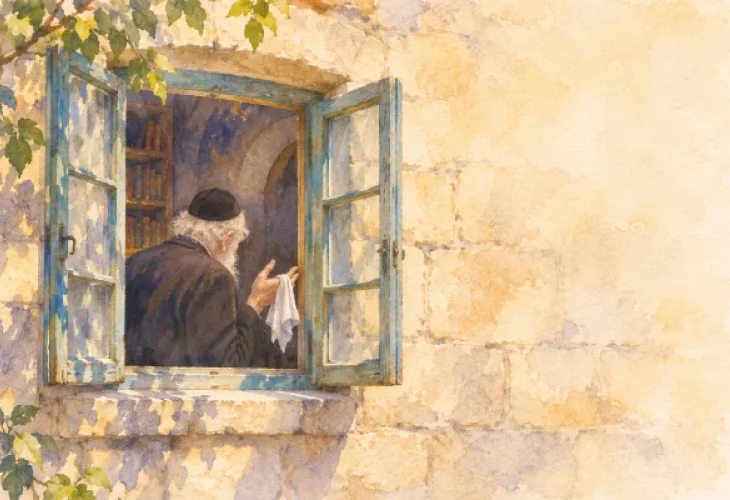
"It's not an illness. It's simply my old age. If you come back tomorrow, it will be the same old age, only one day older."
These were the words of Rabbi Shlomo Zalman Auerbach, when an elderly woman came to seek his advice and apologized for troubling him while he was ill. Although his family had stopped allowing visitors because of his declining health, Rabbi Auerbach noticed the woman waiting outside and insisted that she be allowed in.
The encounter is one of many stories recorded in HaTorah HaMesamachat (The Torah That Brings Joy), a book illustrating the character of one of the leading halachic authorities of his generation. Beyond his extraordinary Torah scholarship, Rabbi Auerbach was known for his humility, sensitivity, and unwavering commitment to Jewish law.
A Life Guided by the Shulchan Aruch
Rabbi Auerbach's wife passed away suddenly on Shabbat at the age of 71. That Saturday night, devastated by the loss, he hurried to Shaare Zedek Hospital in Jerusalem. While riding in an elevator, he encountered a student who was unaware of the tragedy. The student joyfully announced that his wife had given birth to a baby boy. Rabbi Auerbach warmly congratulated him and offered his heartfelt blessings before remaining in the elevator as it continued down to the hospital morgue.
At his wife's funeral, Rabbi Auerbach made a remarkable statement: "It is customary to ask forgiveness from the deceased at a funeral. You know that I have nothing for which to ask your forgiveness, because our entire life together was conducted according to the Shulchan Aruch. Nevertheless, if there was anything between us, I ask your forgiveness."
When someone later wondered whether the couple had truly never experienced disagreements, Rabbi Auerbach explained that during the journey from Shaarei Chesed to Har HaMenuchot, he had tried to recall anything for which he owed his wife an apology. He remembered nothing, but worried that perhaps something had happened that he had forgotten.
Delivering Heartbreaking News
Rabbi Auerbach's mother-in-law was 96 years old when her only daughter died. The family feared that the terrible news might endanger her life, and no one could bring themselves to tell her. Finally, Rabbi Auerbach undertook the painful task himself.
One of his grandchildren recalled watching through the windows as his grandfather gently prepared the elderly woman for the news. Rabbi Auerbach explained that following his wife's stroke, had she survived with complete paralysis, her suffering would have been severe. He then spoke about Hashem's goodness.
"You know," he told her, "the Master of the Universe is entirely good. Everything He does is good. Sometimes we understand it, and sometimes we don't. You should know that the Master of the Universe has taken your daughter to a world that is entirely good."
He asked her to recite Baruch Dayan HaEmet—"Blessed is the True Judge"—together with him, word by word, without crying. "How can I possibly do that without crying?" she asked.
Rabbi Auerbach recited the blessing with her. But when he finished and stepped outside, his composure collapsed. Family members had to support him to prevent him from falling as he wept uncontrollably.
In the following days, his mother-in-law lay in bed each night, lamenting the loss of her daughter in mournful Yiddish verses. Rabbi Auerbach, newly widowed himself, could hear her from the adjoining room and would cry along with her. Her suffering was almost unbearable for him, yet he remained silent throughout the thirty-day mourning period.
After the shloshim, he approached her and explained that the Shulchan Aruch places limits on excessive mourning. Citing the teaching in Moed Katan 27b, he reminded her that she still had grandchildren, great-grandchildren, and great-great-grandchildren to think about.
"What should I do, then?" she asked.
"Begin singing a different melody," Rabbi Auerbach replied. "Sing: 'Master of the Universe, protect my grandchildren and great-grandchildren.'"
His mother-in-law, a sharp and intelligent woman, answered with characteristic wit: "I'm already too old to start singing new melodies. But if the rabbi says that this is the halacha, then halacha is halacha."
Rabbi Auerbach's approach reflected his conviction that while grief must be acknowledged, it should not be allowed to consume a person's life indefinitely. On another occasion, he observed that some families had been devastated by excessive mourning.
When Halacha and Heartbreak Meet
Another remarkable story concerns a young couple studying at an institution for baalei teshuva, Jews who had returned to religious observance. They were engaged, their wedding invitations had been sent, and relatives were arriving from abroad.
Just days before the wedding, the bride casually mentioned that she had previously been involved with a non-Jewish man overseas. This presented a serious halachic problem because the groom was a kohen, and Jewish law prohibits a kohen from marrying a woman who has had certain relationships, including one with a non-Jew.
The groom's rabbi suggested consulting Rabbi Auerbach. Despite the late hour, they arrived at his home after midnight, hoping he might find a solution. After hearing the circumstances, Rabbi Auerbach ruled that, based on the information presented, the marriage was forbidden.
Then, while the visitors were still standing before him, he broke down in bitter tears. Witnesses recalled how deeply he grieved for the young couple whose wedding plans had seemingly been shattered.
Perhaps, the account suggests, those tears had an effect in Heaven. The following day, a Jewish man arrived from Argentina and revealed that he personally knew the bride's former partner. Although the man had presented himself as a non-Jew, he was actually Jewish and had concealed his identity. On the basis of this testimony and additional evidence, Rabbi Auerbach was ultimately able to permit the marriage.
A Lifetime of Humility and Peace
Rabbi Auerbach believed in influencing others through positive means and avoided disputes whenever possible. Although he held firm convictions on public issues, he often refrained from expressing opinions that might deepen divisions within the Jewish community. Toward the end of his life, he made a statement that captured his approach: "Throughout my life, I have bent myself for others, and I have no regrets."
The stories of Rabbi Shlomo Zalman Auerbach reveal a man who combined firm adherence to halacha with extraordinary compassion for others. Whether comforting a grieving relative, sharing in a student's happiness during his own moment of sorrow, or weeping over a painful halachic ruling, he demonstrated that devotion to Torah and genuine sensitivity to human suffering could go hand in hand.
Based on stories recorded in HaTorah HaMesamachat, recounting the life and teachings of Rabbi Shlomo Zalman Auerbach.
 Torah PersonalitiesWhat True Kindness Looks Like: Rabbi Lopian’s Life Lessons
 Torah Personalities“Just Love Every Person”: The Remarkable Life of Rabbi Mordechai Auerbach, zt”l
 Torah PersonalitiesRabbi Shlomo Zalman Auerbach: Life, Legacy, and Inspiring Stories of a Halachic Giant
 MagazineDespite the Agony: Rabbi Shlomo Zalman Auerbach Stopped to Listen

