Relationships
The Jewish Wedding: One Tradition, Many Customs
From the ring and the ketubah to Moroccan henna nights and Persian wedding spreads, Jewish communities around the world have kept one shared law of marriage while creating a rich variety of customs to celebrate it. Here is how the Jewish wedding came to look the way it does.
- Maayan David
- | Updated
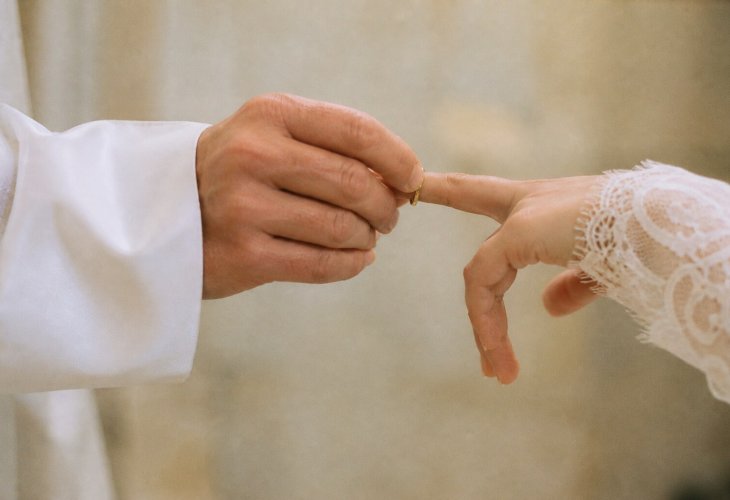 Illustrative image: the groom places a plain gold ring on the bride's finger
On almost any evening of the year, somewhere in the world, a Jewish groom places a simple ring on his bride's finger and recites a short Hebrew formula: Harei at mekudeshet li, "Behold, you are consecrated to me", by this ring, according to the law of Moses and Israel.
The scene might take place in a Jerusalem courtyard, a Brooklyn synagogue, or a wedding hall in Antwerp. The music, clothing, food, and celebrations may be entirely different. But the words will be familiar, and the central elements of the ceremony will be much the same.
That combination of continuity and diversity is one of the most fascinating features of Jewish weddings. Across centuries of exile, migration, and cultural change, Jewish communities have maintained a shared framework of marriage laws. Yet each community has developed its own customs, ceremonies, music, and distinctive ways of celebrating the creation of a new Jewish home.
Some traditions have ancient roots. Others emerged in medieval Europe or the Jewish communities of the Middle East and North Africa. Some have disappeared, while others have been revived by later generations. Together, they tell the story of Jewish marriage not only as a religious and legal institution, but also as a deeply communal and cultural event.
A marriage in two stages
Jewish marriage traditionally takes place in two stages: kiddushin, also known as erusin, and nisuin. Although the two are now performed as part of one continuous ceremony, they were once separated by a considerable period of time.
The first stage, kiddushin, establishes the marriage bond. It is much more than a modern engagement. Once kiddushin takes effect, the couple are legally married, and ending the relationship requires a formal divorce. Nisuin completes the process, allowing the couple to begin their life together as husband and wife.
The Mishnah describes several ways of effecting kiddushin, including the transfer of money or a written document. Over time, the transfer of money became the standard practice, and the money itself came to take the form of a ring.
The language of acquisition used in traditional Jewish marriage law can sound unfamiliar to modern readers. But kiddushin is not understood as the purchase of a woman. The term comes from the Hebrew root meaning holiness or consecration, and the woman's consent is essential to the marriage.
The ceremony also requires two witnesses. Their presence is not merely symbolic: without valid witnesses, the kiddushin is not legally effective. Traditionally, the witnesses must be observant Jewish men who are unrelated to the bride and groom and to each other.
The ring, too, is subject to specific requirements. It must belong to the groom, and Ashkenazi custom generally favors a plain gold ring without a stone. The reason is practical: a gemstone can be difficult to value, and the bride must know what she is accepting.
These rules form the legal foundation of the wedding. Around them, however, Jewish communities have developed an extraordinary range of traditions.
From biblical matchmakers to engagement celebrations
The Jewish tradition of matchmaking is often traced back to the story of Isaac and Rebecca in Genesis. Abraham sends his servant, traditionally identified as Eliezer, to find a wife for his son. When Eliezer meets Rebecca, he is impressed by her kindness: she offers water not only to him but also to his camels. Before leaving her family, Rebecca is asked whether she is willing to go, and she answers that she is.
Jewish tradition has often regarded Eliezer as the first shadchan, or matchmaker. His story also offers a lesson about what to look for in a prospective spouse: character matters.
Matchmaking remains an important part of Orthodox Jewish life. A shidduch is an introduction made with marriage in mind, usually through a professional matchmaker, family member, teacher, or mutual acquaintance. Arranging a suitable match is traditionally regarded as a mitzvah.
Once a couple decides to marry, the engagement may be marked by a celebration. Among Ashkenazi Jews, this is often called a vort, literally "a word," referring to the couple's commitment to one another. In some families, the engagement is accompanied by tena'im, a formal agreement recording the wedding date and the obligations undertaken by the two families.
One of the best-known Ashkenazi engagement customs is the breaking of a china plate by the mothers of the bride and groom. The broken plate symbolizes the seriousness of the commitment and the fact that the agreement cannot simply be undone. Because of the legal complications that could arise from formal engagement agreements, many families today sign the tena'im only shortly before the wedding.
Other Jewish communities developed their own ways of marking an engagement. Among Persian Jews, shirini khoran, meaning "eating sweets," was a celebration in which the groom's family formally expressed its acceptance of the bride's family. In some Ottoman Jewish communities, families exchanged a mandada, a tray filled with sweets and gifts.
The customs varied, but the purpose was similar: to turn a private decision into a public commitment celebrated by two families.
The ketubah: A marriage contract with a long history
One of the most important documents in a Jewish wedding is the ketubah. Written traditionally in Aramaic, it sets out the husband's financial and marital obligations, including his responsibility to provide for, clothe, and honor his wife. It also establishes a sum payable to her in the event of divorce or his death.
The ketubah is not simply a decorative wedding document. It is a legally significant contract, intended in part to protect the wife and ensure that marriage carries real responsibilities.
Its history stretches back well over two thousand years. Marriage contracts discovered at Elephantine, an ancient Jewish settlement in Egypt, date to the fifth century BCE. Much later, the Cairo Genizah preserved thousands of medieval Jewish documents, including ketubot that reveal how marriage arrangements developed across different communities.
Over time, the ketubah also became an important form of Jewish art.
In Italy, particularly during the seventeenth and eighteenth centuries, elaborately decorated ketubot became prized possessions. Artists filled them with intricate borders, flowers, biblical scenes, architectural designs, and family emblems. The city of Ancona became an especially important center of ketubah production. The enthusiasm for elaborate decoration grew so great that local Jewish leaders eventually placed limits on how much families could spend on these documents.
Ashkenazi communities generally took a different approach. The ketubah was usually treated as a standard legal document rather than an opportunity for artistic display, and handwritten decoration was much less common.
The ketubah also reflects important differences in the marital laws that developed among Jewish communities.
Around the year 1000, Rabbeinu Gershom of Mainz issued a series of decrees that profoundly shaped Ashkenazi marriage practices. Among other things, the ban prohibited a man from taking an additional wife and forbade divorcing a woman against her will. Exceptions to the prohibition on polygamy required the approval of one hundred rabbis.
These decrees did not apply universally to all Jewish communities. In many lands under Muslim rule, where polygamy remained legally permitted, Jewish communities developed other ways of protecting wives. Some included a clause in the ketubah requiring the husband's first wife's consent before he could marry another woman.
Thus, even within the shared framework of Jewish marriage law, local communities sometimes developed different legal arrangements to address the realities of their societies.
Preparing for the wedding
In many communities, the celebrations begin well before the wedding day itself.
Among Ashkenazi Jews, the groom is traditionally called to the Torah on the Shabbat before the wedding. Known as the aufruf, from the Yiddish word for "calling up," the occasion is marked with singing, festive refreshments, and sometimes the throwing of sweets.
Many Sephardic communities instead celebrate Shabbat Hatan, the groom's Shabbat, on the Shabbat following the wedding. In some communities, the Torah reading includes the story of Isaac and Rebecca, recalling the biblical origins of Jewish marriage.
Another significant difference concerns fasting on the wedding day.
In many Ashkenazi communities, the bride and groom fast until the ceremony. The day is treated almost like Yom Kippur: they recite penitential prayers, seek forgiveness for past mistakes, and begin their married life with a sense of spiritual renewal. The groom may wear a white kittel, the garment traditionally associated with Yom Kippur.
Many Sephardic communities, by contrast, regard the wedding day as an occasion for uninterrupted celebration and do not observe this fast.
These differences are a reminder that Jewish wedding customs are not always universal. Practices that seem inseparable from a traditional Jewish wedding in one community may be entirely unfamiliar in another.
The veil and the chuppah
In many communities, the celebrations often begin with separate gatherings for the bride and groom. At a certain point, the groom is escorted to the bride for the badeken, the veiling ceremony. He lowers the veil over her face, a custom traditionally associated with Rebecca, who covered herself with a veil when she first approached Isaac.
The ceremony then moves to the chuppah, the canopy under which the marriage takes place. The chuppah represents the home the couple will establish together. Its open sides are often understood as an expression of hospitality, recalling Abraham and Sarah's tent, which was open in every direction to welcome guests.
Although the word chuppah appears in the Bible, the familiar portable canopy is a later development. It is documented in Jewish wedding practice from the early sixteenth century.
Ashkenazi communities often prefer to hold the ceremony outdoors, beneath the open sky. This is traditionally associated with God's promise to Abraham that his descendants would be as numerous as the stars. Sephardic communities, on the other hand, have often preferred indoor ceremonies, particularly in synagogues. In some communities, a tallit, or prayer shawl, is used as the canopy or spread over the couple.
Another familiar Ashkenazi custom takes place before the bride and groom stand together under the chuppah. Accompanied by the mothers, the bride circles the groom seven times, although some families follow a custom of three circles.
The practice is often connected to the biblical verse in Jeremiah: "A woman shall surround a man." It is also understood as symbolizing the bride's creation of a new home around her husband. The number seven, meanwhile, recalls the seven days of Creation and the beginning of a new household.
The ring, the ketubah, and seven blessings
Once the couple are beneath the chuppah, the formal marriage ceremony begins.
The first blessings are recited over a cup of wine, including the blessing of betrothal. The couple drink, and the groom then places the ring on the bride's finger while reciting the traditional formula. In accepting the ring, the bride completes the first stage of the marriage, kiddushin.
The ketubah is then read aloud, traditionally in Aramaic. Its reading marks the transition between kiddushin and nisuin and reminds everyone present that marriage is not only a celebration but also a set of mutual responsibilities.
The second cup of wine introduces the sheva berakhot, the seven wedding blessings. These blessings require a quorum of ten and express a vision of marriage that reaches far beyond the couple themselves.
They begin with the blessing over wine and move through themes of creation, humanity, joy, and the rebuilding of Jerusalem. They recall the happiness of Adam and Eve in the Garden of Eden and conclude with a prayer that the voices of brides and grooms will once again be heard in the streets of Jerusalem.
The blessings connect the couple's personal happiness to the larger story of the Jewish people.
Why break a glass?
Few Jewish wedding customs are as recognizable as the breaking of a glass beneath the chuppah.
The practice is generally understood as a reminder of the destruction of the Temple in Jerusalem. Even at the height of personal happiness, Jewish tradition insists that the community remember its national loss.
The custom has several historical sources. The Talmud describes sages who deliberately broke valuable vessels at wedding celebrations to bring guests back to a sense of seriousness when their merrymaking became excessive. Later authorities connected the practice explicitly to mourning for the destroyed Temple. Rabbi Solomon Luria, a sixteenth-century authority, also associated the broken glass with the broken tablets of the Ten Commandments. Before breaking the glass, the groom first recites the verse from Psalms: "If I forget you, O Jerusalem, let my right hand forget its skill."
The custom even acquired its own architectural expression in some Jewish communities. In seventeenth-century southern Germany, certain synagogues had special wedding stones built into their exterior walls. The groom would smash the glass against the stone, leaving a visible reminder of the ceremony.
The moment the glass breaks, the guests call out mazal tov, and the formal ceremony gives way to celebration.
In many Ashkenazi communities, the couple then enter a private room for yichud. This is their first opportunity to spend a few moments alone as a married couple, and traditionally they break their wedding-day fast there. Many Sephardic communities do not include this custom.
A world of wedding traditions
The basic legal structure of the Jewish wedding is remarkably consistent. But the celebrations surrounding it have differed enormously from one Jewish community to another.
In medieval Ashkenazi communities, weddings were major communal events. In the Rhineland towns of Speyer, Worms, and Mainz, the entire Jewish population could become involved in the festivities. Rabbi Jacob Moelin, known as the Maharil (1355, 1427), recorded many of the customs of his time, including pre-wedding celebrations known as mayen, processions, and music.
German Jewish communities also developed distinctive wedding accessories. One unusual tradition involved a wide belt that encircled the bride and groom together beneath the chuppah, physically joining them as a symbol of their new bond.
In Morocco, wedding celebrations traditionally included an elaborate henna evening. Family members applied reddish henna paste to the bride's hands amid music, sweets, and wishes for blessing and protection.
The Moroccan bride might wear the magnificent keswa el-kbira, or "great dress," an elaborate traditional outfit consisting of a velvet skirt decorated with gold bands, a richly embroidered bodice, sheer sleeves, and a gold belt. The colors varied by region: deep red was popular in some coastal and southern communities, while green and blue appeared elsewhere. Often given to the bride by her father, the dress could remain part of her wardrobe for family celebrations throughout her life.
Yemenite Jewish weddings were equally elaborate, with celebrations traditionally extending over an entire week. The festivities began in the groom's home on the preceding Shabbat, and henna ceremonies were an essential part of the preparations. The groom had his own henna celebration, separate from the bride's.
The bride's wedding attire could be spectacular, featuring layers of silver and gold jewelry and an elaborate, towering headdress covered in beads and ornaments. Today, many Israelis of Yemenite descent have revived the traditional henna ceremony, preserving a connection to their families' history and heritage.
Persian Jewish weddings had their own distinctive visual centerpiece: the sofreh aghd, an elaborate cloth spread before the couple. It was covered with symbolic objects, including bread, a mirror, coins, and sweets, each representing a hope for the couple's future. Families sometimes added a sacred book.
Another Persian custom involved holding a cloth above the bride and groom while relatives rubbed sugar cones over it, allowing sugar crystals to fall onto the couple as a wish for a sweet life together. Guests expressed their joy with kell, a distinctive ringing cry.
The descendants of Spanish Jewry carried their wedding traditions throughout the Mediterranean and beyond. In Ottoman Jewish communities, a designated messenger, known as the kombidador, would visit homes in the neighborhood to invite residents to the wedding personally. In some wealthy families, the bride's dowry was carefully listed and read aloud as part of the celebrations.
Syrian Jews developed a rich musical tradition for weddings, singing pizmonim: Hebrew religious hymns set to Arabic melodies. In London's Spanish and Portuguese Jewish community, weddings traditionally took place in an elegant synagogue setting, often accompanied by choral music and concluding with Psalm 150.
Farther east, the Jews of Cochin in India developed wedding customs unlike those of either European or Middle Eastern communities. Historical depictions show the bride seated near the Torah ark, with a long cloth suspended from the ceiling to cover her, while her embroidered skirt remained visible below.
These traditions were not simply decorative additions to the wedding. They reflected the communities' languages, clothing, music, local artistic traditions, and relationships with their surrounding societies. A Moroccan henna ceremony, an Italian illuminated ketubah, and a Persian wedding spread each expressed Jewish marriage through a different cultural vocabulary.
The obligation to celebrate
For all their differences, Jewish wedding celebrations share one important principle: making the bride and groom happy is a mitzvah.
The Talmud discusses the question of how guests should dance before a bride. It records that Rabbi Judah once danced with a myrtle branch in his hand, while other sages went to extraordinary lengths to entertain newlyweds. The message is clear: even the most distinguished scholars should set aside their dignity when it comes to bringing joy to a bride and groom.
That spirit remains alive in Jewish weddings today. Guests dance, sing, perform acrobatics, and sometimes display astonishing feats of balance and coordination. In traditional settings, men and women generally celebrate in separate circles.
The wedding meal itself is considered a seudat mitzvah, a festive meal with religious significance. It concludes with Grace After Meals, followed by the seven wedding blessings.
Nor does the celebration end when the wedding hall empties. For seven days, many communities observe sheva berakhot gatherings, hosting the newlyweds at festive meals with family and friends. The seven blessings are recited again when the appropriate conditions are met, including the presence of a new guest who has not yet participated in the couple's celebration.
The idea is to extend the joy of the wedding beyond a single evening, allowing the couple to begin married life surrounded by the support of their community. For all the differences between Jewish communities, the purpose of wedding traditions is always the same: to celebrate the creation of a new Jewish home, and to welcome it into a tradition much older and larger than the couple themselves.