

Israel News
Netanyahu Offers Eisenkot First Term as Prime Minister in Unity Government Bid
Benjamin Netanyahu and Gadi Eisenkot are set to hold talks on forming a national unity government after Netanyahu proposed an unprecedented leadership rotation, offering Eisenkot the first term as prime minister
- Shlomi Diaz
- | Updated
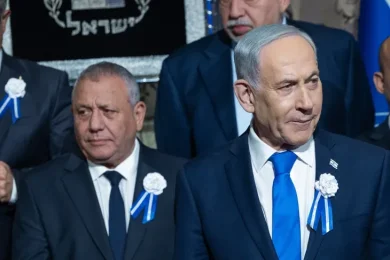
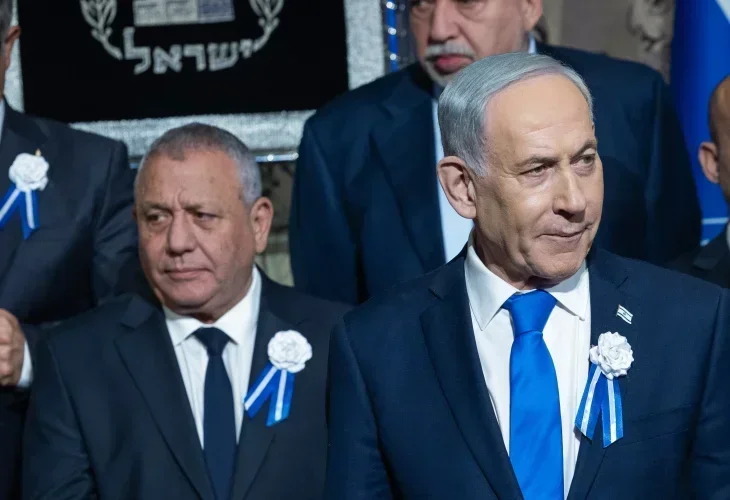 Netanyahu and Eisenkot (Photo: Chaim Goldberg, Flash90)
Prime Minister Benjamin Netanyahu and Yashar party chairman Gadi Eisenkot are scheduled to meet Sunday morning at the Dan Accadia Hotel in Herzliya to discuss forming a national unity government. The meeting follows Netanyahu's announcement Saturday night that he would be willing to let Eisenkot serve first as prime minister under a rotation agreement, a significant concession aimed at advancing negotiations between the two political rivals.
Eisenkot responded by inviting Netanyahu and his team to direct talks, saying he was prepared to assess Likud's commitment to forming a genuine unity government. "If Likud is ready for genuine unity, I am prepared to assess its seriousness over the next 24 hours," he stated.
Eisenkot also claimed that his representatives had submitted a detailed proposal to Netanyahu the previous Sunday through a confidential channel established at the prime minister's request. According to Eisenkot, his team had spent approximately three weeks attempting to conduct serious negotiations but had encountered resistance and delays. Likud officials rejected the allegations, insisting that Eisenkot had offered no meaningful compromises, either through official negotiations or confidential discussions.
Netanyahu Cites Court Developments and Political Divisions
In a lengthy statement published on X on Saturday night, Netanyahu called for the establishment of a national unity government, citing recent developments in his corruption trial and growing political divisions in the Knesset.
The prime minister declared that "truth and justice have come to light in court," referring to a November 25 hearing at the Jerusalem District Court. During the hearing, judges reportedly expressed serious doubts about the prosecution's case and recommended reconsidering two of the three corruption cases against him.
The judges reportedly suggested dropping Case 4000, involving allegations that Netanyahu exchanged regulatory favors for favorable media coverage, and reassessing Case 2000, concerning his discussions with newspaper publisher Arnon Mozes. They also encouraged efforts to reach a resolution in Case 1000, which involves allegations concerning gifts received from wealthy benefactors. Although the recommendations represented a setback for prosecutors, they did not constitute an acquittal or a final ruling.
Netanyahu thanked those who had supported him throughout the legal proceedings, particularly his wife, Sara, and their sons, Yair and Avner. He also condemned recent incidents in the Knesset, including lawmakers leaving the chamber during the national anthem, turning their backs on combat veterans suffering from trauma, and what he described as disrespectful treatment of bereaved families.
The prime minister went on to criticize the prospect of a future government dependent on Arab political parties. He accused those parties of promoting policies that could undermine Israel's security and Jewish character, including expanded family reunification arrangements for Palestinians, territorial withdrawals, and the establishment of a Palestinian state.
Netanyahu also cited the recent defeat of legislation intended to prevent the return of terrorists' bodies to their families, arguing that the vote demonstrated the dangers of such a coalition. His allegations formed part of his appeal for a government composed of parties that recognize Israel as the nation-state of the Jewish people.
Netanyahu Agrees to Serve Second in Rotation
Turning to the possibility of a unity government, Netanyahu said that recent political and legal developments had prompted calls for national unity, including from Israelis who had not previously supported him. "Unity is the need of the hour," he declared, arguing that Israel faces immediate security challenges requiring cooperation across the political spectrum.
Netanyahu said a unity government would need to reach agreements on major policy issues, including military conscription and Torah study, in coordination with potential Haredi coalition partners. He emphasized that Likud remained Israel's largest party, claiming it had received approximately 250,000 more votes than Eisenkot's party. Under ordinary circumstances, Netanyahu argued, that would justify his serving as prime minister or at least taking the first term in a rotation agreement.
Nevertheless, he said he was prepared to set aside that principle in the interest of national unity. "Given the magnitude of the existential danger and the possibility that a government incapable of confronting it could be formed, my responsibility as a leader requires me to put everything aside, including the principle of the largest party," Netanyahu wrote.
He announced that he would agree to Eisenkot serving as prime minister first, while he would initially hold the position of alternate prime minister.
Unity Talks Face Significant Obstacles
Netanyahu concluded by calling for immediate negotiations, stressing that any agreement would require meaningful compromises from both sides. He said he expected "genuine, sincere, and accelerated negotiations," with a similar willingness to make concessions from Eisenkot and his political partners.
Despite the apparent opening, significant differences remain between the two sides over the composition and policies of a potential government. Questions surrounding military conscription, judicial reform, and the participation of other political parties could complicate efforts to reach an agreement.
Eisenkot's willingness to meet Netanyahu represents a potential step toward direct negotiations, although his statements indicate that he remains skeptical of Likud's intentions. The planned meeting comes amid efforts to form a new governing coalition, with both sides facing pressure to clarify their positions and determine whether a national unity agreement is politically feasible.
For now, Netanyahu's willingness to let Eisenkot serve first as prime minister marks a notable shift in his negotiating position. Whether the proposal can bridge the remaining political differences, however, remains to be seen.
 Israel NewsNetanyahu Weighs Presidency in Proposed Deal to Form Israeli Unity Government
 Israel NewsNetanyahu and Eisenkot Clash Over Iranian Threat Amid Unity Government Talks
 Israel NewsNetanyahu Calls for National Unity Government; Eisenkot Dismisses Appeal as Political Stunt
 Israel NewsLikud and Gadi Eisenkot Hold Unity Government Talks Amid Disagreements

