

Wonders of Creation
The Science of Cellular Recognition: How Your Body Knows What Belongs
How does the body know which cells belong and which are dangerous? Discover the fascinating science behind neurons, the immune system, and cancer research.
- Yehosef Yaavetz
- | Updated
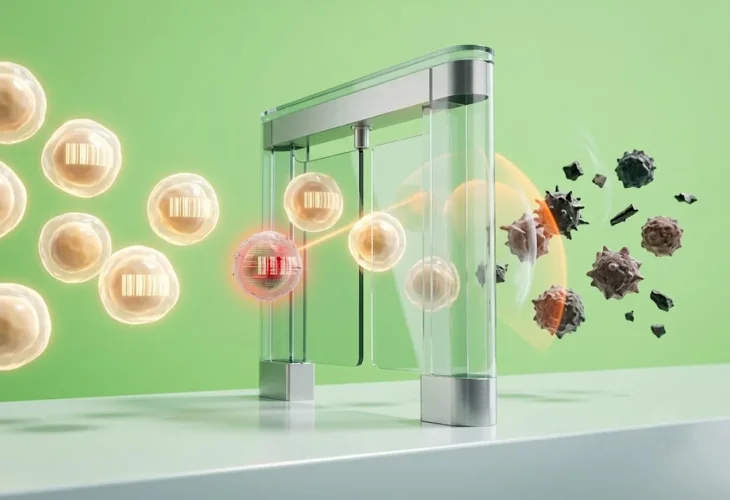
How does the body recognize itself?
At first, it sounds like a joke. Maybe it simply looks in the mirror and gives itself a wink.
But in reality, this is one of the most remarkable questions in biology.
The human body is made up of trillions of cells working together in extraordinary harmony. At the same time, it is constantly surrounded by bacteria, viruses, damaged cells, and other unwanted intruders. Every moment, each cell must somehow determine whether the cell beside it is a trusted partner or a potential threat.
For the body to survive, it must continually sort what belongs from what does not. It has to distinguish between friend and foe, healthy and damaged, useful and dangerous. Some cells need to be preserved, while others must be broken down, removed, or destroyed.
Every Neuron Has Its Own Identity
Recognition is not only important for defending against disease. It is also essential for the brain itself.
The brain contains billions of neurons, and our ability to think, remember, and learn depends on these neurons forming precise connections with one another. However, not every neuron should connect with every other neuron.
Different groups of neurons perform different jobs. Some process vision, others hearing, while countless additional regions handle movement, language, memory, and many other functions.
The question is: how does a neuron know which other neurons belong to its own network?
A genetic test would not solve the mystery because every neuron carries the same DNA. If neurons connected randomly, the results could be disastrous. Imagine seeing sounds, hearing smells, or completely confusing one sense with another.
Scientists have discovered that each neuron carries something resembling a unique barcode.
Just as products in a supermarket have different barcodes, every neuron has its own identifying pattern that allows neighboring neurons to recognize whether they belong together.
A Biological Barcode
This remarkable discovery was made in recent years by researcher Kenzio, earning him a prestigious scientific prize.
The barcode is created through a process known as genomic folding. Much like a computer generates a unique code for every webpage, genomic folding creates an identifying pattern for each individual neuron.
Because this process is extraordinarily complex, it can generate billions of unique barcodes within a single human body, allowing neurons to recognize the correct partners with astonishing precision.
The Body's "Don't Eat Me" Signal
Recognizing enemies is the responsibility of the immune system.
Specialized immune cells constantly patrol the body, searching for bacteria, viruses, damaged tissue, and cancer cells.
How do they know what to attack?
Healthy cells display what scientists have informally nicknamed the "don't eat me" signal. Immune cells called macrophages recognize this signal and leave those healthy cells alone while destroying harmful ones.
Cancer cells, however, can exploit this system.
Some cancers learn to imitate the "don't eat me" signal, fooling the immune system into treating them as normal, healthy tissue.
Even more remarkably, recent research has found that some cancer cells do not bother creating a convincing imitation at all.
Instead, they simply steal proteins from healthy cells and use the portion that carries the protective signal.
This deception allows them to hide from the body's natural defenses, making them even more dangerous.
A New Approach to Cancer Treatment
Understanding this process has opened the door to promising new cancer therapies.
One of the newest experimental approaches focuses on identifying cells that contain these stolen proteins.
Researchers discovered that when a cancer cell steals a protein from another cell, it leaves behind subtle physical changes. One of those changes is a difference in the cell's overall mass.
The new treatment is designed to identify cells whose mass differs from that of healthy cells, suggesting they may have acquired stolen proteins through this process of biological impersonation.
By targeting these suspicious cells, scientists hope to help the immune system recognize and eliminate cancer cells that have managed to disguise themselves.
The discovery offers another fascinating glimpse into the extraordinary intelligence built into the human body. Every second, countless microscopic decisions are being made, allowing trillions of cells to distinguish friend from foe, preserve healthy tissue, and defend the body against disease.

