

Behind the News
After Trump-Netanyahu Meeting, Iran Conflict Enters a Waiting Game
The leaders reaffirmed their shared goal but offered no timeline, red lines or public agreement on how far the next campaign should go
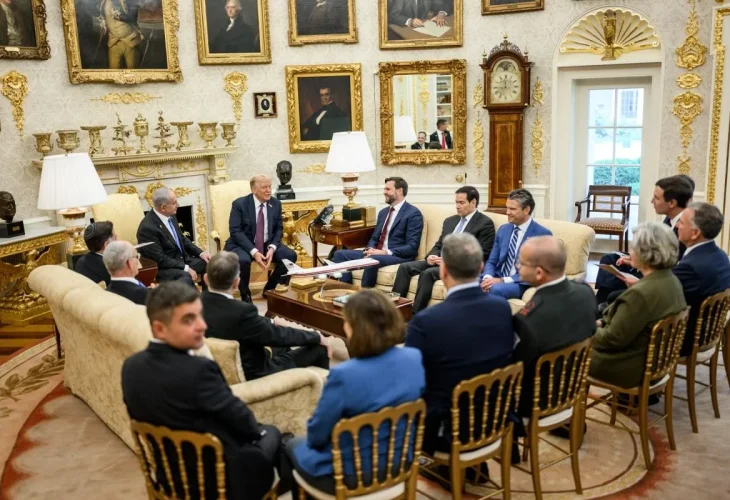 Photo from the meeting (White House)
President Donald Trump and Prime Minister Benjamin Netanyahu emerged from their White House meeting proclaiming unity over Iran, but without announcing any concrete decision on the next phase of the conflict. Within hours, Iran fired ballistic missiles toward American facilities in Jordan, while the United States and Saudi Arabia carried out strikes against Iran-aligned groups in Iraq.
The developments left the central question unanswered: Did Trump and Netanyahu agree on a strategy for confronting Iran, or did they only reaffirm their shared goal of preventing Iran from obtaining nuclear weapons?
Netanyahu described the talks as one of his best meetings with an American president. “It was a conversation with full partnership, mutual support and an understanding of the shared goal of ensuring Iran does not have nuclear weapons,” he said.
Trump called it a “very good meeting,” while the White House described the discussion as “positive and productive.” Neither side announced a timetable for negotiations, new military action or the conditions under which the United States would resume a wider campaign.
Senior military, intelligence and diplomatic officials from both sides were in the room, and the two leaders did not meet separately at any point. The American delegation included Vice President JD Vance, Secretary of State Marco Rubio, Defense Secretary Pete Hegseth, CIA Director John Ratcliffe and envoy Steve Witkoff. Netanyahu was joined by senior national security, military and diplomatic advisers.
With both teams in the room, the meeting gave the two sides an opportunity to review intelligence, military options, diplomacy and the risks of further escalation. They may also have discussed the boundaries of the next phase, including which targets remain off-limits, what Iranian actions could trigger new attacks and how much freedom Israel would have to act, although neither government disclosed whether any such understandings were reached.
The two governments appear to agree on the final objective but remain divided over how quickly and broadly to act.
Israel has sought greater freedom to strike Iranian strategic and economic targets. Defense Minister Israel Katz said Washington was continuing to block attacks on Iran’s energy sector.
“We very much want to strike Iran’s energy targets. The United States is not approving it at the moment,” Katz said yesterday.
American officials fear that attacks on Iranian oil, electricity and other major infrastructure could trigger retaliation against Saudi Arabia and other Gulf states, disrupt global energy supplies and draw the United States into a longer regional war.
Trump has instead attempted to combine military pressure with negotiations. He has warned that the United States could resume attacks if Iran refuses to reach an agreement, but he has not publicly imposed a deadline.
That raises the first major question facing both leaders: How long will Washington allow diplomacy to continue?
Trump appears to believe that economic pressure, military damage and uncertainty over future attacks may eventually force Tehran to compromise. Iran, however, appears to believe that it can wait out the United States by raising the military, political and economic costs of continued involvement.
The second question is what Iranian action would trigger another major American campaign.
Neither Trump nor Netanyahu has publicly said whether the threshold would be an attack that kills American troops, renewed high-level uranium enrichment, rebuilding at damaged nuclear sites, prolonged disruption of the Strait of Hormuz or a strike on Gulf energy infrastructure.
Iran’s missile launch toward Jordan showed how quickly the conflict could widen. Jordan said it intercepted five missiles aimed at locations that included American military facilities, while the United States and Saudi Arabia struck weapons and logistical sites in Iraq linked to more than 30 drone attacks carried out over the previous 72 hours. Iran did not publicly connect its launch to the White House meeting, but the timing reinforced its warnings that further escalation could put US forces and regional allies at risk.
Israel must also decide how long it can accept the current restrictions. A Reuters report today said Iran is expected to receive hundreds of Chinese-made shoulder-fired air-defense systems, although Beijing denied supplying the weapons.
For Israel, the report strengthens concern that every pause gives Iran time to repair damaged capabilities and prepare for another round. Trump must weigh that concern against the risk that a broader offensive would provoke attacks across the region and damage the global economy.
The next phase will therefore depend on three competing calculations. Trump believes continued pressure and patience may produce an agreement. Netanyahu fears that patience may allow Iran to recover. Tehran appears to believe that missile attacks, regional pressure and the threat of economic disruption can weaken American resolve.
The White House meeting showed that Trump and Netanyahu remain aligned on the destination. It did not reveal whether they have agreed on the road, or how long either leader is prepared to wait before choosing a different one.

