

Magazine
Sudden Blindness Opened My Eyes: The Inspiring Journey of Avichai Yaish
After a tragic accident left Avichai Yaish blind at 17, he found renewed faith, discovered a new purpose, became a teacher, and learned to see the world in a way that sight alone never could
- David Fried
- | Updated
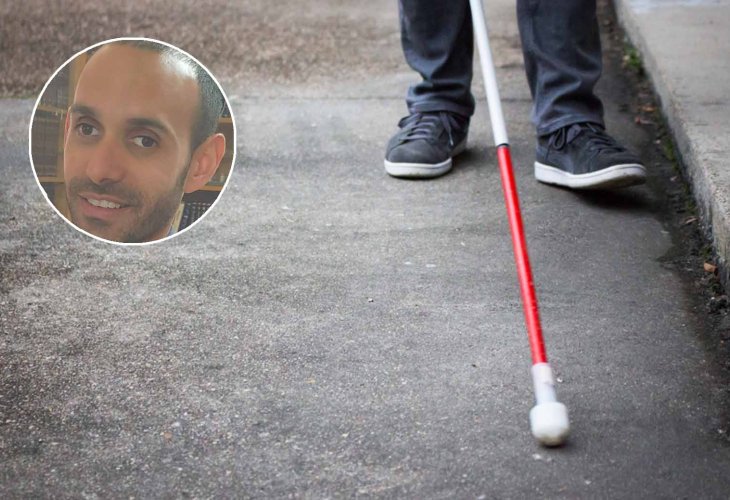 Inset: Avichai Yaish (Photo: Courtesy of the family)
At the age of 17, Avichai Yaish's life changed forever. A seemingly harmless schoolyard game ended in a devastating injury that caused him to lose his eyesight. Today, he divides his life into two chapters: before blindness and after it.
"I am married, have children, and work in a profession that surprises almost everyone when they first hear about it," he says with gratitude. "But none of this was obvious or guaranteed."
A Split Second That Changed Everything
Avichai grew up in the city of Rehovot in a Modern Orthodox family. Although he observed Shabbat and kept kosher, he admits that Judaism was not the center of his life.
"I was religious in some ways and secular in others," he recalls. "I was looking for excitement and pleasure much more than Torah and mitzvot."
Everything changed during his senior year of high school. Like many teenagers, he and his classmates played rough physical games during breaks. What began as harmless fun gradually became more aggressive. During one of these games, a stronger friend lifted him off the ground and spun him around. As he fell, the area between his eye and temple struck his friend's knee.
"I stood up and asked if I was bleeding because I felt the impact," he remembers. "He said everything looked fine. I put some ice on it and thought that was the end of the story."
It was only the beginning.
His Vision Disappeared Overnight
Until that day, Avichai had perfect eyesight.
The following day, while trying to copy notes from the classroom board, he realized he could no longer read what was written.
"At first I thought I was imagining it," he says. "I asked the student next to me if he could see the board, and he looked at me as if nothing was wrong."
Within another day, his condition deteriorated dramatically. "I looked toward the front of the classroom and couldn't even recognize the teacher standing only about a meter away. All I could see was a blurred shape."
Realizing this was an emergency, he rushed to the hospital.
Doctors performed examination after examination, but no one could explain what was happening. Specialists examined him, countless tests were performed, steroids were administered, yet nothing stopped his vision from disappearing.
"I even asked them if they could just give me glasses," he recalls. "They looked at me seriously and told me it was far more complicated than that."
During those terrifying weeks, his eyesight continued to fade until he could no longer even read the prayer book in the synagogue.
Four Months Without Answers
For four months, Avichai moved back and forth between home and the hospital. The uncertainty was almost as painful as the blindness itself.
Yet something unexpected happened during that period. "I saw people whose suffering was much greater than mine," he says.
He remembers a patient who could not walk because of severe leg problems, another young woman who could not move her hands and had to be fed by her father, and patients who could not even breathe without assistance.
"Seeing them changed my perspective. I realized there were still so many things I could be grateful for. I could walk, speak, breathe, and think. That completely changed the way I looked at my own situation."
Eventually, after four months, doctors identified the cause: Leber's disease, a rare hereditary condition that damages the optic nerve.
Then came the devastating news. "This is how your life is going to be," they told him. "You need to learn to live with it."
When Medicine Reached Its Limits
His mother desperately asked whether surgery could restore his vision. The doctors explained that the problem originated in the brain and that surgery could be life threatening.
"That was the moment we realized my life had changed forever," Avichai says.
But something else changed as well. "Until then, all my hope was in the doctors. After that conversation, I realized that my real hope was not in medicine but in God."
Although he had grown up religious, his faith had never been deeply personal.
During his hospitalization, religious relatives and volunteers from Bnei Akiva visited him and encouraged him with words of faith.
"When the doctors told me nothing more could be done, those words came back to me. I understood that the ultimate Healer is God."
For the first time in his life, he spoke to God sincerely. "I cried out to Him and asked why this had happened to me. It wasn't a prayer I was reading from a siddur. It came straight from my heart."
Soon afterward, he began wearing tzitzit and putting on tefillin every day. "I stopped seeing the world through my eyes and started seeing it through my ears."
Seeing Beyond Appearances
Losing his eyesight transformed the way he viewed people.
"When appearances disappeared, I began discovering who people really were," he explains. "I realized that what matters most is not how someone looks but how they speak, how they think, and what kind of person they are."
People he had once admired suddenly seemed empty, while others he had previously overlooked revealed themselves to be wise, compassionate, and deeply meaningful.
"I realized that until then I had been living in a world that revolved around appearances."
Marriage, Family, and a New Beginning
At age 20, Avichai moved to the community of Beit El to study in yeshiva. There he met the woman who would become his wife.
Ironically, she had been one of the Bnei Akiva volunteers who visited him during his hospitalization. "She saw far beyond my blindness," he says. "She saw who I really was."
People sometimes tell his wife, "What a righteous woman you are for marrying him."
Her response is always the same. "They only say that because they don't know him."
A Blind Teacher Inspiring the Next Generation
Perhaps the most surprising chapter of Avichai's story is his career. He became a schoolteacher.
Finding work was not easy. "Many doors were literally slammed in my face when employers saw me arrive with a guide dog."
Eventually, Rabbi Yitzchak Sharvit helped him find a principal willing to give him a chance.
Today, he successfully manages a classroom. Although one student occasionally assists him with practical tasks, Avichai says discipline and teaching are no obstacle.
"The children quickly realize that they can't fool me. After a month or two, we develop an excellent relationship."
Forgiveness Instead of Bitterness
What about the friend whose accidental blow caused his blindness?
"Not only have I forgiven him," Avichai says, "we're still close friends." In fact, that same friend once drove him to lectures where Avichai shared his life story. "He always tells me that because of what happened to me, he himself returned to Judaism."
"I Am Much More Than My Blindness"
Today, Avichai travels throughout Israel sharing his remarkable journey of faith, resilience, and gratitude.
His message is simple: "Healthy people often have stereotypes about those with disabilities. I want people to understand that I am much more than my blindness."
His life is a powerful reminder that while physical sight can be lost, true vision often begins when we learn to see with the soul.

