

World News
Report: War Didn’t Stop Iran’s Nuclear Program; It May Have Enough Material for 10 Bombs
American media cited experts who believe a significant part of Iran’s nuclear capability survived the attacks. The experts warned: "The capability still exists. The Iranians could produce a bomb in less than a year."
- Shlomi Diaz
- | Updated
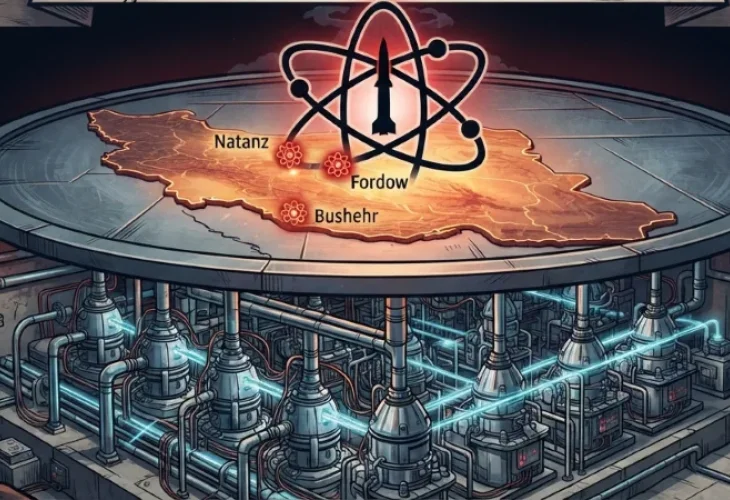
The New York Times reported on Shabbat that Western nuclear experts monitoring developments in Iran believe the strikes on nuclear sites significantly slowed Iran’s nuclear program—but did not destroy it.
The newspaper quoted Ellie Geranmayeh, an Iran expert and author of Iran Nuclear Monitor, the Iranian nuclear-monitoring project of the European Council on Foreign Relations. According to her, "The capability still exists." In addition, Daryl Kimball, executive director of the Arms Control Association, argued in a recently published analysis that the war demonstrated that Trump’s "maximum pressure" policy and military actions failed—and cannot—completely erase Iran’s nuclear capabilities.
It should be noted that Iran’s three main nuclear sites were attacked, but it is impossible to verify what happened to the enriched uranium, since Tehran is preventing International Atomic Energy Agency (IAEA) inspectors from accessing the nuclear sites.
Those quoted in the report noted that IAEA inspectors also believe Iran still possesses a quantity of uranium enriched to a level close to that required for weapons—which, after further processing, could be enough to produce up to 10 nuclear bombs.
Western intelligence reports determined that most of Iran’s highly enriched uranium stockpile is stored in the Isfahan area. In February, the IAEA estimated that the site contained about 440 kilograms of uranium enriched to 60%—an amount that, through further enrichment and processing, could be enough to produce nine or 10 nuclear bombs within weeks.
The nuclear complex in Isfahan was heavily damaged in the American and Israeli strikes in June 2025, and two facilities used for uranium conversion or enrichment are still classified as having sustained significant damage. But according to assessments, the uranium stockpile itself was not destroyed—and is likely still at the complex.
According to a more detailed assessment by experts at the Institute for Science and International Security, approximately 265 to 287 kilograms of the stockpile may be buried in Isfahan, while up to another 80 kilograms may be at Fordow, although that figure has not been officially confirmed—the remainder is likely in the Natanz area.
Intelligence officials also assess that "Pickaxe Mountain" contains a centrifuge-production facility deep underground that could withstand even bunker-busting bombs. According to experts, the site is not yet operational, but satellite images showed that construction continued there even after the June 2025 strikes. U.S. President Donald Trump threatened to strike that site as well, but has so far refrained from doing so.

