

Magazine
From Grief to Prayer: A Mother’s Journey Toward Hope and Redemption
After the tragic loss of her son, one mother discovered how personal pain could be transformed into prayer, purpose, and a deeper longing for the Redemption
- Michal Arieli
- | Updated
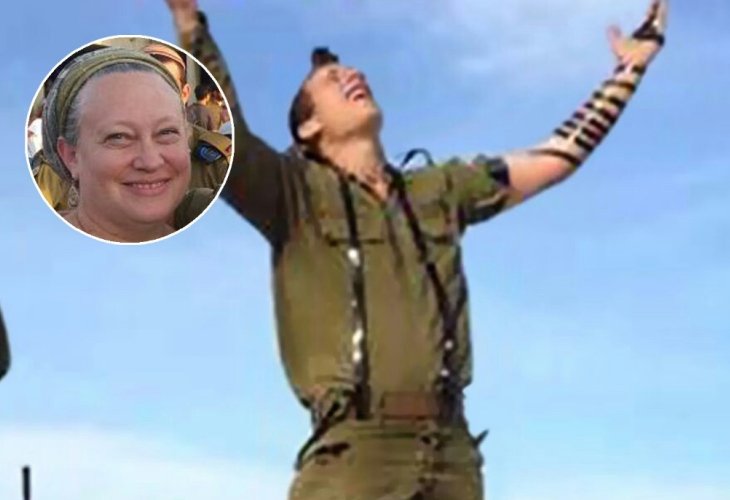 David Goloventzitz, z"l, and (circled) his mother, Esti Goloventzitz
The 11th of Tammuz 5777 was a devastating day for the Goloventzitz family of Efrat. Their son David, an officer serving in the Samaria region, was killed in a tragic shooting accident. The loss struck the family without warning and changed their lives forever.
"After David passed away, I was in a very difficult emotional state," recalls his mother, Esti Goloventzitz. "I tried to understand why it had happened and why I had been chosen to be a mother for only 22 years."
Three weeks after David's death, Esti heard a talk by Rabbi Dov Singer of the Mekor Chaim Yeshiva about the sorrow of the Divine Presence.
"Rabbi Singer explained that there can be a deeper meaning to profound sorrow. When Hashem allows a person to experience the greatest pain a parent can endure, He is, in a sense, allowing that person to share in the sorrow of the Divine Presence and the pain of exile. Those words entered my heart very deeply. Suddenly, through my own grief, I began to understand the sorrow of the Master of the Universe."
Wouldn't thinking about additional sorrow only deepen your own pain?
"At first glance, of course it would seem to add to my personal grief," Esti acknowledges. "But that is only on the surface. Rabbi Nachman spoke at length about how someone experiencing suffering can find joy in having been chosen by the Master of the Universe to become a partner.
"I have certainly not reached the level where I can rejoice in such suffering. I am still not in a place where I can say thank you for a tragedy like this. But Rabbi Singer's words never left me. Slowly, I began to understand that I had to take the tragedy I had experienced and somehow use it to create something meaningful, to build something out of the destruction. The problem was that I had no idea how to do that."
A Message That Changed Her Perspective
After her son's passing, Esti also came across a book containing letters written by the Lubavitcher Rebbe to bereaved families.
"The book was deeply moving, but two ideas particularly touched me. The first was how much the Rebbe emphasized focusing on life and continuing to build it. We must continue living with joy, knowing that the person who has left us would want to see us happy and that our happiness brings joy to their soul as well.
"The second idea was that although we accept suffering with love, at the same time we should 'demand' that Hashem finally bring the Redemption. We should say to Him, 'We will not let go until You redeem us.'"
These ideas led Esti to think about the many other mothers throughout the Jewish people facing painful challenges of their own. She began thinking about the unique spiritual strength of mothers and of women in general.
"That was when the idea first came to me to organize a day of prayer," she explains. "I wanted us to transform pain into prayer and ask Hashem to finally say, 'Enough' to our suffering."
The idea gradually developed until it became a reality. Esti shared it with anyone willing to listen, and she says Hashem sent the right people to help make it happen, including Rabbi Shmuel Eliyahu, Rabbi Shlomo Katz, and Rabbanit Yemima, who participated in the event.
Had you always been the type of person to initiate and organize major events?
Esti smiles.
"Not at all. Really, not at all. I had never initiated or organized anything. But this time, I felt that my son David was somehow giving me his strength, because he was exactly the opposite of me. He was energetic and active, and he had a highly developed sense of justice. If something needed to change, he would follow what he believed was true with everything he had.
"After this entire event, I felt that it was a joint project between Hashem, David, and me."
Asking Hashem to Say "Enough"
The special prayer gathering took place on a Thursday afternoon on the Mount of Olives.
"It is difficult to describe how moving and overwhelming it felt to stand there," Esti recalls. "There was an enormous group of women praying and pleading together. We truly felt the Divine Presence. It was incredibly powerful. We felt that, with Hashem's help, our prayers could truly change reality."
Rabbi Shmuel Eliyahu addressed the women and helped them appreciate the spiritual significance of the place where they were standing. Rabbi Shlomo Katz then spoke about prayer and the longing for the restoration of the Temple service, when the Kohanim would once again perform their service and the Levites would return to their song.
Finally, Esti addressed the women herself and shared what was in her heart.
She quoted a teaching cited in Mei HaShiloach that explains that out of Hashem's love for the Jewish people, He sometimes sends an intense cry immediately before salvation so that a person will develop a deep thirst for redemption.
Esti illustrated the idea through Joseph. During his 12 years in prison, she explained, Joseph was able to live with extraordinary faith and acceptance. Yet according to the teaching she cited, on the night before his salvation, he cried out over how long his suffering would continue and prayed for deliverance. The cry itself preceded the salvation.
"I told the women that it is not simply that because we pray, Hashem decides to save us," Esti explains. "Rather, Hashem already wants to redeem us, but He wants us to have the privilege of becoming partners in that Redemption. That is why He awakens us to plead with Him and to ask."
The women then recited selected Psalms, Anim Zemirot, and portions of the Yom Kippur Katan prayers, as the gathering took place on the eve of the month of Nissan.
The date had been chosen deliberately. Nissan is traditionally associated with redemption, and Esti noted that righteous women played an essential role in bringing about the Jewish people's redemption from Egypt.
"I feel that we can absolutely do it again," she says.
Learning to Truly Long for Redemption
Esti believes that the enormous spiritual energy of the gathering can be continued through much smaller, everyday actions.
"In every prayer and every Grace After Meals, we ask for Jerusalem to be rebuilt. But how much do we really think about the reality of Jerusalem being rebuilt? Unfortunately, and I include myself in this, most of us do not think about it enough.
"Perhaps that is the small commitment each of us can make. We can try to pray for the Redemption and genuinely long for it, so that one day, when the Messiah comes, we will not be surprised. We will truly have been waiting for him."

