

History and Archaeology
Buried for 1,700 Years: Was Pompeii the Roman Sodom and Gomorrah?
Pompeii was buried by Mount Vesuvius and rediscovered centuries later. Its ruins reveal a society steeped in corruption and immorality, with a surprising reference to Sodom and Gomorrah.
- Yehosef Yaavetz
- | Updated
After Titus completed the destruction of the Temple, he returned to Rome for lavish victory celebrations. The famous Arch of Titus, which survives to this day, commemorates the Roman victory and depicts Jewish captives carrying the menorah.
But the celebrations did not last.
Titus became seriously ill from a creature that developed in his brain, and he died young and in agony. Rome, too, was struck by a devastating disaster. Mount Vesuvius erupted, burying two entire cities and their inhabitants: Pompeii and Herculaneum.
The Roman writer and naturalist Pliny, who witnessed the catastrophe, described the terrifying scene:
“Ash began falling on our heads, though not in great quantity. I looked back. A dark mist was following us, spreading over the ground like a cloud... Night fell. The darkness was complete, like in a room whose windows had been shuttered. You could hear the wailing of women, the screams of children, the shouts of men. Some called for their children, some for their parents, some women for their husbands, trying to recognize one another by their voices. One mourned his bitter fate, another the fate of his family; some begged for death...”
Pliny’s father perished in the disaster. Pliny himself managed to escape by boat into the open sea.
The Lost City of Pompeii Is Rediscovered
About 1,700 years passed.
Then, a farmer in the Campania region was digging in his field when he felt his plow strike carved stone. He dug further and discovered the top of a tower.
Slowly, word of the discovery spread until the military engineer Karl Weber, a protégé of King Charles III, arrived at the site. Weber began excavating carefully and uncovered streets, houses, and what appeared to be the remains of an entire city.
At first, he had no idea which ancient city he had discovered. Then an inscription bearing the name Pompeii was uncovered.
It became clear that the catastrophe described in Pliny’s ancient account had truly occurred. More than that, the entire city of Pompeii had been buried beneath meters of volcanic material.
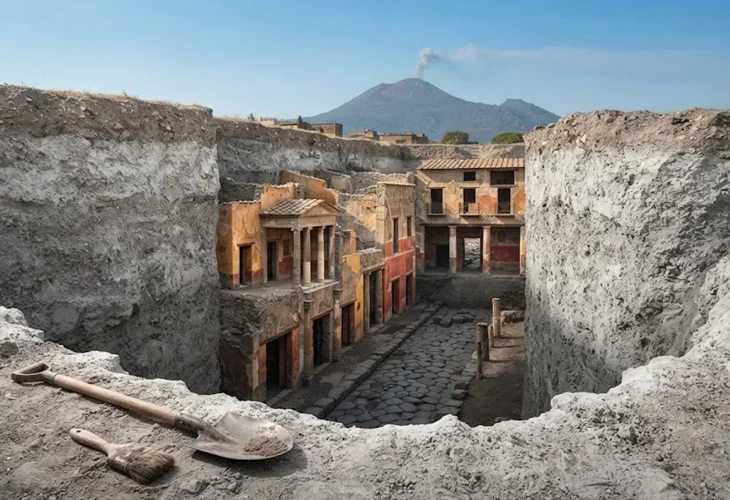
For more than two hundred years, Pompeii has been excavated. The city has still not been uncovered in its entirety, but most of it has now been revealed, offering a remarkable glimpse into Roman life before the eruption of Mount Vesuvius.
Was Ancient Pompeii Like Sodom?
The archaeological findings reveal a city steeped in pleasure and sin, drawing a striking comparison to the biblical city of Sodom.
The luxurious homes of Pompeii’s wealthy residents reveal a society built in part on the exploitation of male and female slaves in the ugliest ways imaginable. The number of taverns throughout the city is astonishing, while surviving wall paintings and graffiti document a culture of sin, debauchery, and indulgence.
Evidence of political corruption can also be found in ancient inscriptions on the city’s walls, some of which survived as though they had been written on the very day of the eruption.
In Pompeii’s auditorium, which survived intact, idolatrous performances were staged and cruel games were held. The Romans exploited the poor and the enslaved while focusing on pleasure and the satisfaction of their desires.
The contrast between the lives of the wealthy and the enslaved was stark. Slaves lived in small, wretched rooms and received meager food, while the homes of the wealthy were magnificent and included enormous bathhouses. These baths were filled by slaves who carried jars of water from the river on their shoulders, one after another.
“In Pompeii, slaves were treated as speaking objects,” says a site researcher, as described in the Pompeii museum.
A Mysterious Reference to Sodom and Gomorrah
Perhaps the most surprising discovery is an ancient Greek inscription found in Pompeii containing the words “Sodom and Gomorrah.”
It is possible that someone living in the city recognized a resemblance between Pompeii and the sinful cities described in the Torah.
What that person could not have known was how striking the comparison would eventually become.
Like Sodom and Gomorrah, Pompeii became a symbol of a prosperous society consumed by corruption and immorality before meeting a sudden and devastating end. Mount Vesuvius buried the city, preserving beneath the volcanic material an extraordinary record of the civilization that had existed there.
Centuries later, when Pompeii emerged again from beneath the earth, its streets, homes, inscriptions, and artifacts revealed not only how its inhabitants lived, but also a chilling parallel to the biblical account of Sodom and Gomorrah.

