

Magazine
From Autopilot to Presence: A Father’s Journey to Meaningful Parenting
Nadav Gedalia shares how fatherhood, faith, gratitude, and Torah transformed the way he connects with his children and taught him to find purpose beyond success and numbers
- Moriah Luz
- | Updated
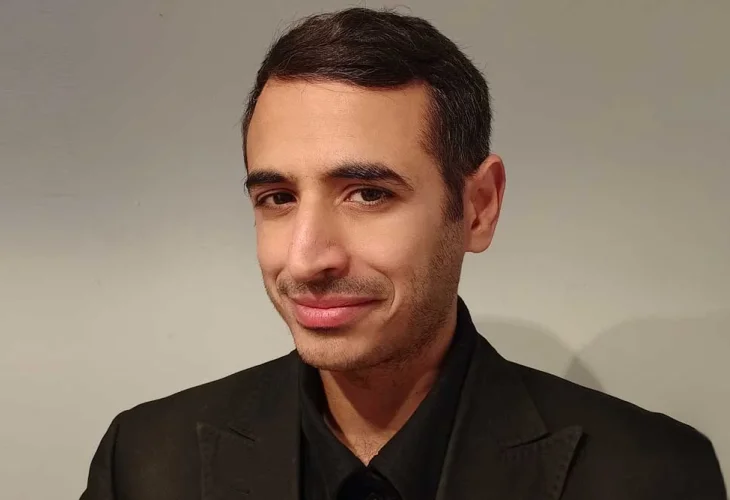 Nadav Gedalia
On one chilly Shabbat morning, at six o’clock, Nadav Gedalia already knew that Shacharit would not look the way he had imagined. His young son insisted on coming with him to the synagogue and firmly refused to stay behind. The boy’s vulnerability melted Gedalia’s heart. He agreed, bundled him up, and together they stepped out into the cold morning air.
They arrived at the synagogue, but Gedalia never went inside. Instead, he remained in the lobby beside his son, who needed his constant presence. The prayers continued on the other side of the door.
It was through small, everyday moments like this that Gedalia began to discover that fatherhood was inviting him into unfamiliar territory. He saw himself reflected in his child, including his own sensitivity and fears. At the same time, he discovered within himself a growing desire to be truly present as he raised his children.
“You Create Because That Is Your Role”
Gedalia, now in his late thirties, is married and a father. He grew up in what he describes as a deeply rooted Yemenite Jewish home, one that did not fit neatly into any particular category. Today, he writes and creates content, has produced several documentary films about his life, created short online videos about studying Talmud, and published a book of Torah insights.
How did you enter the world of writing and content creation?
“I’ve been writing stories and composing music since I was a child. A lot of prayer eventually led me to pursue it seriously, while trying to understand what my purpose is in this world.
“At first, my creativity came from a sense that something was missing in my personal life. I was convinced that attention from others would fill that void. When you have the privilege of growing older, and that really is a privilege that shouldn’t be taken for granted, that whole idea of needing attention starts to seem almost funny.”
If it no longer comes from a desire for attention, what drives your creativity today?
“It comes from understanding that you create because that is your role. You’re not ‘contributing’ to society. You’re simply doing what is yours to do.”
Gedalia’s life journey has involved a constant search for the way of life that feels right and authentic to him. As a single man, it took time before he found the woman with whom he would build his home.
“I don’t belong to a particular sector. I’m simply a deeply rooted Yemenite Jew, a Jew who wants to do Hashem’s will. I couldn’t find a category like that ‘on paper,’ and for a while I thought something was wrong with me. Eventually, I realized that it was actually a tremendous blessing.”
“I Wasn’t Really There”
Gedalia met his wife when he was 27, and before long their oldest daughter, Talia, was born. When their second child, Eden, arrived, Gedalia began to realize that fatherhood was more complicated than he had expected.
He describes his son as a sensitive child who reminded him very much of himself. Many of the challenges Gedalia experienced as a father were therefore internal ones.
“One very typical experience for me was taking him to preschool in the morning. He was a sensitive, gentle child, and I found it very difficult to leave him there and walk away. Other people might say that’s ridiculous, but for me it was genuinely difficult. You’re connected to him, you love him, you want him to be happy, and suddenly something as simple as dropping him off at preschool and leaving becomes difficult.”
Those complicated feelings led Gedalia to suppress his emotions and operate as a father almost on autopilot.
“I did everything a father is supposed to do,” he explains. “I watched the children when necessary, did the shopping, worked, and paid the bills. Emotionally, too, I played with them and hugged them. But I wasn’t really there.
“Obviously, on paper it looked as though I was present. But looking back, you say, ‘Wow, where was I then, and where, thank God, have I been privileged to reach after going through this process?’”
Tell us about that process. What did you discover about yourself?
“I tried to connect more deeply with my children, and honestly, I also tried to connect more deeply with myself. I believe those two things are connected.”
As he worked on reconnecting with himself, Gedalia began to understand what had been getting in the way.
“The home is our own little corner that God has given us, and it’s where we supposedly relax. The problem begins when we tell ourselves that relaxing means turning to screens, newspapers, or some other external distraction.
“I realized that I relax much better through walking, exercise, and nature, by getting outside. It’s better to open the door and, with your ‘last ounce of strength,’ as people say, get yourself outside for a walk, listen to good music, or learn Torah. Those things can reconnect you with yourself. From there, they can actually help you grow and give you far more strength and patience for your children than you imagined.”
“The Greater the Challenge, the Greater the Joy”
These insights did not come overnight. Gedalia decided to document the process he was going through without knowing where it would lead. He simply took out a camera and began filming ordinary situations with his son.
Eventually, he edited the footage into a full-length film called A Father With God, which he now screens for groups by invitation. The film followed an earlier project, Single With God, and was later followed by another film, A Home With God.
What does being a father mean to you?
“Fatherhood is part of the natural order of life. Precisely because it is so natural, we become accustomed to it and settle into whatever feelings we already have about it. But parenting means being born again all the time. The greater the challenge, the greater the joy.
“Life is always busy. It doesn’t give us much time to breathe and stop for a moment to look at the tremendous wonder that is right in front of us: our children.”
What gives you the greatest satisfaction as a parent?
“Parenthood itself is the satisfaction. There are so many jokes that portray parents as people who are constantly ‘suffering.’ Imagine someone gives you a Porsche as a gift, and you’re miserable because a cup of coffee spilled inside it. Apparently, you’ve forgotten that someone gave you a Porsche.
“We constantly look for something new so that we can feel excited again. But if you don’t have enough gratitude for what you already have, then seeking something new isn’t really renewal. It’s just trying to fill a hole that has no bottom.”
Learning to Put Things in Perspective
Another major part of Gedalia’s life is Talmud study. To date, he has created dozens of short online videos presenting ideas from the Gemara and has also written a book of Torah insights.
“I was fortunate that my parents sent me to schools where Gemara was taught. Still, it took me time to really enter into the learning.”
About twenty years ago, Gedalia decided to undertake the ambitious goal of completing the entire Talmud through the Daf Yomi cycle. He became deeply immersed in the project.
“Not long ago, I completed the Talmud for the fifth time. The previous time I completed it was on my wedding day. We held a festive meal, and it was a very moving and special occasion.
“After being privileged to study thousands of pages of Gemara, it seemed natural to try to pass some of that learning on to others. That’s how the online series Gemara in a Minute began, where I present short passages from the Gemara following the order of the tractates.
“There isn’t a huge audience,” he admits candidly, “but there is an audience that looks for this kind of content and loves it. When someone goes out of their way to send you a message and tells you that the learning genuinely helped them, I think that’s incredible.”
It sounds like you invest quite a lot in these videos, yet the number of views isn’t always particularly high. Was there ever a point when you thought about giving up?
“When I started, I thought the project might be too complicated. I spoke to my wife, and she suggested that I begin with just one video. I saw that the number of views and likes wasn’t very high, and I wondered whether I should continue.
“But every time, Hashem seemed to send me some kind of sign encouraging me to keep going.”
Those moments of encouragement came in different forms. Once, an unfamiliar young man wrote to wish him a happy new year and congratulate him on the videos. Another time, someone he met at the supermarket complimented him on them.
But the comment that helped him most came from his wife.
“She said to me, ‘Suppose you have a video with 80 views and five people gave it a like. Maybe those don’t sound like impressive numbers. But imagine you gave a class in a synagogue with 80 people sitting there, and afterward five of them came over and said, “Thank you.” Wouldn’t that be amazing?’
“Once I began looking at it that way, I learned to put things into perspective and pay less attention to the numbers.
“I hope that one day I’ll be able to do this with full funding and greater peace of mind, but for now I understand that this is what is possible. I won’t pretend it is always easy, especially when you’re not exactly making piles of money or gaining fame from it. But overall, I try to fulfill my mission. That is an enormous privilege, and Hashem has His own ways of showing encouragement.
“There will always be challenges,” he concludes. “That’s true in this work, and of course it’s true when raising children. I believe we need to approach those challenges with lightness and humor, do the job that is ours to do at each moment as best we can, and also understand that not everything depends on us.”

