

Behind the News
A Pro-Israel Shift Is Sweeping Parts of Latin America
From a new Honduras agreement to Colombia’s recognition of Israeli sovereignty over the Golan Heights, governments across the region are strengthening ties with Jerusalem
- Shlomo Hodges
- | Updated
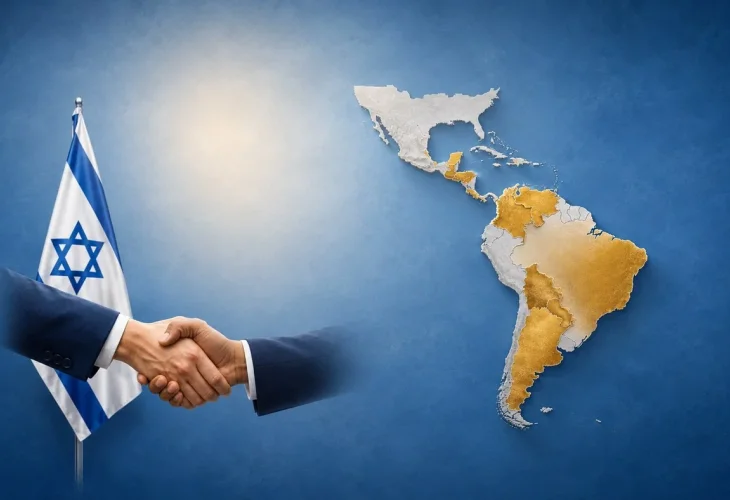
Israel and Honduras signed a memorandum of understanding Sunday to deepen defense cooperation, as ties between Israel and several Central and South American governments continue to strengthen.
Israeli Defense Minister Israel Katz and Honduran Defense Secretary Enrique Rodríguez Burchard signed the accord during a meeting in Israel. It establishes a framework for long-term defense cooperation and builds on an existing security relationship between the two countries. Honduras already maintains its embassy in Jerusalem, making it one of a small number of countries to do so.
Colombia offers an even more dramatic example. President Abelardo de la Espriella’s government recognized Israeli sovereignty over the Golan Heights earlier this month, making Colombia only the second country after the United States to formally adopt that position. The Colombian government cited the territory’s strategic importance to Israel’s security amid continued regional instability.
The move marks a sharp reversal from former president Gustavo Petro, who severed diplomatic relations with Israel in 2024 over the war in Gaza. Since taking office, de la Espriella has moved quickly to rebuild ties. The two governments have agreed to restore full diplomatic relations, exchange ambassadors, lift visa requirements, resume Colombian coal exports to Israel and move Colombia’s embassy to Jerusalem. Colombia also agreed to withdraw from South Africa’s case against Israel at the International Court of Justice.
Bolivia has undergone a similar reversal. It restored diplomatic relations with Israel in December 2025 after President Rodrigo Paz took office, reversing the previous government’s decision to cut ties during the Gaza war. His administration also removed visa requirements for Israeli travelers as part of a broader shift in Bolivia’s foreign policy.
Other governments have built on existing ties with Israel. Costa Rica signed a free-trade agreement with Israel in December 2025, which still requires legislative ratification. Since taking office, President Laura Fernández has supported a stronger relationship with Israel and expressed willingness to upgrade Costa Rica’s diplomatic representation in Jerusalem to embassy status.
Elsewhere, governments already friendly toward Israel have continued to deepen those ties. Argentina has become one of Israel’s strongest allies in the region under President Javier Milei. He has repeatedly voiced support for Israel and pledged to move Argentina’s embassy to Jerusalem when conditions allow.
Paraguay has already taken that step. President Santiago Peña reopened the country’s embassy in Jerusalem in December 2024, restoring a diplomatic presence that had previously been moved to Tel Aviv.
Perhaps the most unexpected development has come from Venezuela, long one of Israel’s fiercest critics in Latin America. Caracas and Jerusalem agreed last week to establish a mechanism for consular services after a 17-year diplomatic rupture. The two countries have not restored full diplomatic relations, but the agreement marks a notable break from years of Venezuelan alignment with Iran.
Domestic political changes are a major part of the realignment. Several recently elected governments have shifted to the right while also seeking closer relations with the United States, Israel or both.
Israel has also made Latin America a diplomatic priority. Foreign Minister Gideon Sa’ar designated 2026 as a year of strategic focus on Latin America, while Israel and the United States have launched a joint working group aimed at strengthening ties across the region.
Brazil could become the most consequential test of the trend. President Luiz Inácio Lula da Silva is seeking reelection against a field led by right-wing Sen. Flávio Bolsonaro, with recent polls showing the race tightening ahead of the first round on October 4. Brazil’s relations with Israel have deteriorated under Lula, who withdrew the country’s ambassador from Israel in 2024 and later joined South Africa’s case against Israel at the International Court of Justice.
A Bolsonaro victory could produce another major reversal. Flávio Bolsonaro has pledged to move Brazil’s embassy to Jerusalem within the first six months of his presidency and has openly called for restoring closer ties with Israel. Prime Minister Benjamin Netanyahu has also publicly backed his campaign. As Latin America’s largest country, a Brazilian realignment toward Israel would significantly strengthen Israel’s position in the region.
The trend does not extend across the entire region. Nicaragua remains openly hostile toward Israel, while other Latin American governments continue to take more critical positions on the Israeli-Palestinian conflict. Nevertheless, the recent developments in Honduras, Colombia, Bolivia, Costa Rica and even Venezuela point to a significant improvement in Israel’s diplomatic position across parts of Latin America.

