

Simchat Torah
Shemini Atzeret & Simchat Torah: One More Day With Hashem
Your Guide to Shemini Atzeret & Simchat Torah: the meaning, customs, hakafot, and spiritual opportunities of this joyful final holiday of Tishrei
- Yam Sarah Kohen
- | Updated
Shemini Atzeret
Shemini Atzeret literally means “the pausing of the eighth day.” Although we were commanded to celebrate Sukkot for seven days, as the Torah states, “On the fifteenth day of this seventh month is the Festival of Sukkot, seven days for the Lord.” (Leviticus 23:34), Shemini Atzeret is considered the eighth day of the Chag.If Sukkot Was Meant to Last Seven Days, Why Do We Have Shemini Atzeret?
Shemini Atzeret is characterized as a day when the Jewish people pause to spend one additional day with Hashem. Essentially, Hashem, who has been enjoying spending time with us throughout the seven days of Sukkot, all of Elul, Rosh Hashanah, and Yom Kippur, tells us: “Do you really have to go? Can’t you stay a little longer?”
And so, we stay for another day with Him.
Rashi cites the parable of a king who invites his sons to dine with him for several days. When the time finally comes for them to leave, the king asks them to stay for just one more day because it is difficult for him to part from them.
A different, but related, interpretation is offered by Yaakov Zevi Mecklenburg, who translates atzeret as “retain.” Throughout the holiday season, we have experienced a heightened religious passion and a deeply devoted spirit. This final day gives us an opportunity to reflect on everything we have gained, with the hope that we can retain it throughout the rest of the year.
Simchat Torah
Simchat Torah marks and celebrates both the conclusion of our annual cycle of weekly Torah readings and the beginning of a brand-new cycle.
Simchat Torah is like one enormous siyum! It is a time when we express our joy that not only did we receive the Torah, but we continue learning its laws and striving to live according to its ways.
Hakafot
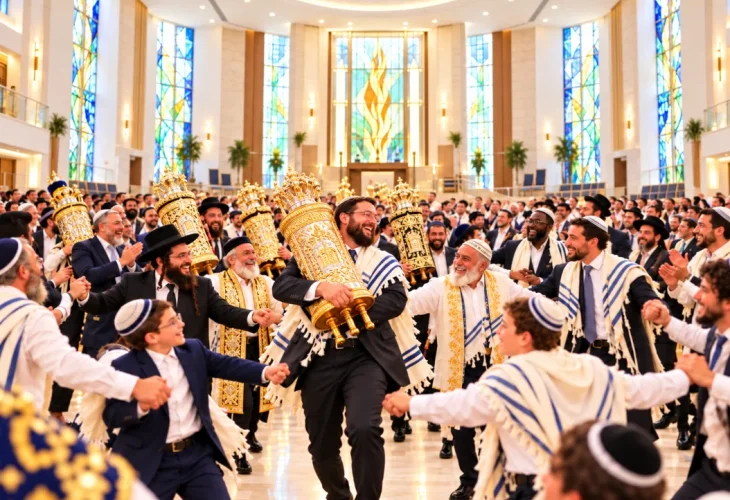
One of the highlights of Simchat Torah is the hakafot, which take place both at night and again in the morning. During the hakafot, we march and dance with the Torah scrolls around the bimah in the synagogue.
The deeper idea behind hakafot is that they have the power to break down spiritual barriers between us and Hashem. Just as encircling Yericho caused its walls to collapse in the days of Yehoshua, the hakafot can break down the walls of separation that stand between us and Hashem.
The Vilna Gaon used to say that the Shechinah itself, Hashem’s Divine Presence, rests upon the bimah on Simchat Torah, and therefore he would not allow anyone to sit on it.
The Chidushei HaRim explains that when we hold a Sefer Torah and dance with it, we are essentially making an oath to live our lives in accordance with the Torah.
Think about that for a moment. Hakafot are a very big deal.
The great Mashgiach of Mir, Reb Yeruchem Leibovitz, ZT”L, once said that he did not know which was more spiritually powerful: the prayers of Yom Kippur or the dancing of Simchat Torah. Both have the power to break down barriers between us and Hashem.
Take advantage of this holy time!
Another beautiful part of Simchat Torah is that Jews from all different backgrounds can come together around the Torah. We are all Jewish, and the Torah belongs to every one of us, no matter how far we may have gone from it, we are still Jewish no matter what. When we come on Simchat Torah to dance with the Torah, we are essentially declaring: This is the truth. This is who we are. And B”H, this is how we want to live.
The Special Energy of Each Hakafah
Each hakafah releases its own unique spiritual energy. At least at the beginning or end of each hakafah, one should try to have kavannah for that particular energy, so that we can become a vessel to receive it.
First Hakafah: Avraham Avinu — Chessed
Avraham represents loving-kindness and chessed.
We ask Hashem to help us become kinder, more compassionate, and more giving people.
Second Hakafah: Yitzchak Avinu — Gevurah
Yitzchak represents gevurah: inner strength and discipline.
We ask Hashem to make us stronger and more focused, to help us stand up for what is right, and to give us the strength to avoid sin.
Third Hakafah: Yaakov Avinu — Tiferet
Yaakov represents tiferet: balance and harmony.
Too much chessed can become destructive. For example, this can become problematic when raising children. Avraham’s chessed produced Yishmael. At the same time, too much gevurah can also destroy. Yitzchak produced an Eisav.
Only when chessed and gevurah are properly blended do we reach perfection. Yaakov represents that balance. All of his children were holy and together became Am Yisrael.
So after asking Hashem for chessed and gevurah, we now ask Him to give us the ability to balance them and use each one in the proper proportion.
Fourth Hakafah: Moshe Rabbenu — Netzach
Moshe represents netzach: eternity, victory, and perseverance.
Netzach is the ability not to allow the external circumstances of life to defeat us. A person may have the proper balance of chessed and gevurah, which is tiferet, but still struggle to fulfill his mission because of an unsupportive family or community, difficulties at work, health challenges, or other obstacles.
Netzach is the quality that allows us to become unstoppable despite those difficulties.
This was the quality of Moshe Rabbeinu. He had a mission, and he carried it out despite opposition, criticism, and rebellion. Moshe remained strong in the Torah and its values and continued leading the Jewish people.
Fifth Hakafah: Aharon HaKohen — Hod
Aharon represents hod: glory, peace, and gratitude.
Aharon was a lover of peace. He saw the good in every person and allowed others to shine.
So after asking Hashem for perseverance, we now ask for the opposite quality as well: the ability to step back, notice other people, and make room for them.
This may also be why this hakafah is considered a segulah for parnassa. When we open our hearts to others, Hashem opens Himself to us and gives us what we need.
Sixth Hakafah: Yosef Hatzadik — Yesod
The sixth sefirah, yesod, represents the balance between the aggressiveness of Netzach and the passivity of Hod.
Too much Netzach, and a person can become too heavy. Too much Hod, and a person can become so busy focusing on everyone else that he never accomplishes his own goals.
Yosef Hatzadik himself achieved this balance. On the one hand, he had the inner strength not to be crushed or influenced by Egyptian culture, whether he was living in poverty or affluence. He remained untouched by the negative influences that could have destroyed him.
At the same time, Yosef was able to manage and supervise an entire world economy by helping others shine and taking joy in their success, an essential quality of a successful leader.
So after asking Hashem for Netzach and Hod, we ask Him for the ability to balance the two.
Yosef is a true tzaddik, and may we merit to always choose what is right, just as Yosef did.
Seventh Hakafah: David Hamelech — Malchut
David represents Malchut.
The first six hakafot form two groups of three in which opposing forces are balanced. According to the Zohar, the seventh sefirah, Malchut, is an empty vessel. It is a receptacle for all the spiritual powers that came before it.
David HaMelech understood that he had nothing of his own. Everything was a gift from Hashem. Even his very life was not his own; he received 70 years from Adam HaRishon.
His life was nothing more than a reflection of the glory of Hashem.
Therefore, during this final hakafah, we pray that our own lives will be completely devoted to reflecting Hashem’s glory. We ask to become a vessel for His light, rather than for our own egos.
Fun Facts
A: Outside of Israel, the holiday lasts two days: Shemini Atzeret on the first day and Simchat Torah on the second.
B: Simchat Torah is a separate holiday from Sukkot; therefore, we do not sit in the sukkah on it.
C: One may sit in the sukkah on Simchat Torah only if the sukkah was invalidated before the holiday.
D: At Kiddush on the night of Simchat Torah, the blessing of Shehecheyanu is recited!
E: Disclaimer: Women should not do Hakafot! They can watch the men, and accept the bracha!
Completing the Torah
A: On Simchat Torah, we complete the Torah with the reading of ParashatVezot Haberachah.
B: In most Jewish communities, the custom is for everyone to receive an aliyah to the Torah on Simchat Torah.
C: According to the Ashkenazi custom, one congregant receives an aliyah, and all the children who have not yet reached Bar Mitzvah age go up together with him. A tallit is spread over all of them, and he recites the blessing over the aliyah before and after the reading.
D: In most communities, there are two “chatanim”: Chatan Torah and Chatan Bereishit. According to the Yemenite custom, there is only one Chatan Torah, and he is also the one who reads Parashat Bereishit.
E: We dance and rejoice on the holiday in honor of the Torah, and clapping is also permitted, unless it falls on Shabbat.
F: The Yemenite custom is to bring small children into the synagogue for the first time on Simchat Torah.
G: Torah scrolls are taken out into the streets of the city after Simchat Torah, and people rejoice and dance in honor of the Torah.
This article is based on teachings from the Judaism With Love booklet, Rabbi Raphael Avitan, and additional Torah learning, shiurim, and sources, with full credit and appreciation to them.

