

Sukkot
The Science Behind Your Lulav: What Makes the Date Palm So Special?
It survives extreme heat, reaches deep underground for water, and produces incredibly sweet fruit. Discover the remarkable science and Jewish meaning behind the date palm we hold every Sukkot.
- יהוסף יעבץ
- | Updated
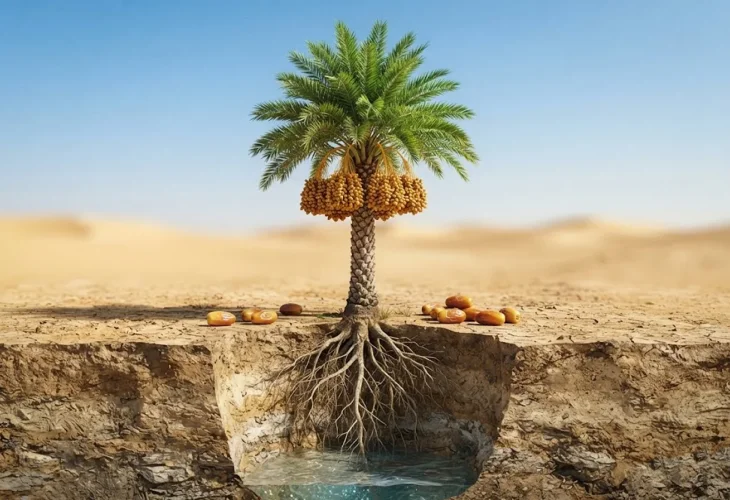
We know its fruit, we recognize its towering silhouette, and every Sukkot, we hold one of its young leaves in our hands. But the date palm is far more remarkable than it might appear.
It can flourish in some of the hottest, driest environments on earth, sending its roots deep underground in search of water while producing extraordinarily sweet fruit high above the desert floor. Its unusual structure even helps illuminate a striking teaching of the Sages.
The Gemara describes the date palm with these words: “Just as this date palm has only one heart, so too the Jewish people have only one heart for their Father in Heaven” (Megillah 14a).
What exactly is so unusual about the “heart” of a palm?
A Tree That Grows Differently
The date palm (Phoenix dactylifera) is a monocot, placing it in a very different botanical group from familiar broadleaf trees such as oaks, maples, and apple trees.
Those trees have a vascular cambium that produces new layers of tissue and allows their trunks to undergo secondary growth, becoming wider over time. Palms do not grow in the same way. Their trunks contain vascular bundles distributed throughout the stem rather than the familiar concentric growth rings of many woody trees.
Instead of continually adding rings of wood, the date palm grows primarily upward from a growing point at its crown. Mature date palms can reach impressive heights, sometimes around 20 meters or more.
And while we see the tall trunk above ground, another remarkable system is working beneath it.
Date palms are famously suited to arid environments. Unlike plants with a single taproot, the palm develops a fibrous root system. Some roots can penetrate several meters into the soil, helping the plant reach available moisture even in extremely dry surroundings. Its leaves are also adapted to limit unnecessary water loss.
This combination helps explain how date palms can thrive in places where many other fruit-bearing plants would struggle.
The Palm’s One “Heart”
At the top of the palm lies its apical meristem, the central growing point from which new leaves develop.
This point is crucial. Unlike many branching trees, a single-stemmed palm cannot simply replace its main growing point with another branch if that growing point is destroyed. Severe damage to the palm’s “heart” can therefore kill the entire plant.
Suddenly, the language of the Sages becomes particularly evocative: “This date palm has only one heart.”
The Gemara, of course, was teaching a spiritual idea rather than giving a botany lesson. The Jewish people may be made up of countless individuals, communities, and personalities, yet at their deepest level they are united by one orientation: “one heart for their Father in Heaven.”
And every Sukkot, we actually hold a young palm leaf in our hands.
The lulav is a developing frond from this remarkable plant. Beneath it stands a trunk constructed very differently from an ordinary woody tree; below the ground spreads an extensive root system; and near the crown is the vital growing point from which new leaves continually emerge.
How the Desert Produces Such Sweet Fruit
Perhaps the greatest surprise of the date palm is its fruit.
A tree capable of thriving under intense heat and limited water produces one of the sweetest fruits we eat.
As dates mature, their chemistry changes dramatically. Their moisture content generally decreases while sugars become increasingly concentrated. Depending on the variety and stage of ripeness, glucose, fructose, and sucrose make up much of the fruit’s carbohydrate content.
That is why a ripe date can pack so much sweetness into such a small fruit.
Dates are rich in carbohydrates and also provide dietary fiber, minerals, and a variety of plant compounds. Their exact nutritional composition varies considerably depending on the cultivar, growing conditions, and stage of ripeness.
Dates also have a special place in Jewish tradition. The “honey” mentioned among the seven species for which the Land of Israel is praised is traditionally understood by the Sages as referring to date honey.
The connection between the date palm and the Land of Israel therefore stretches far beyond the fruit bowl.
King David famously declares in Tehillim: “The righteous shall flourish like a date palm” (Psalms 92:13).
The comparison is especially beautiful when we consider the nature of the tree itself.
The date palm can grow in harsh surroundings. Its visible environment may appear dry, yet beneath the surface its roots search for the water that sustains it. It continues reaching upward, and despite the conditions around it, it produces abundant, sweet fruit.
The image offers a powerful metaphor for spiritual growth. A person may also pass through difficult or spiritually dry periods. What matters is where the roots reach, what sustains the person beneath the surface, and what kind of fruit ultimately emerges.
The Torah gives us another memorable image of the date palm shortly after the Exodus from Egypt. At Elim, the Jewish people encountered “twelve springs of water and seventy date palms, and they camped there by the water” (Exodus 15:27).
Water and date palms appear together: hidden sustenance and visible growth.
And then comes Sukkot, when the date palm becomes part of the holiday itself. Palm branches are commonly used as schach, and the lulav is one of the Four Species we hold during the holiday.
Perhaps that makes the date palm particularly fitting for Sukkot. It is a plant that reminds us that strength does not always come from easy surroundings. Sometimes the deepest roots develop precisely because water is difficult to reach.
The palm searches downward, grows upward, and produces sweetness.
“The righteous shall flourish like a date palm.”

