

History and Archaeology
On the Rooftops: How Yemen’s Jews Celebrated Sukkot Centuries Ago
Why did Yemenite Jews build their sukkahs on rooftops, and what made their etrogim so distinctive? Discover the fascinating Sukkot customs preserved in Yemen for centuries.
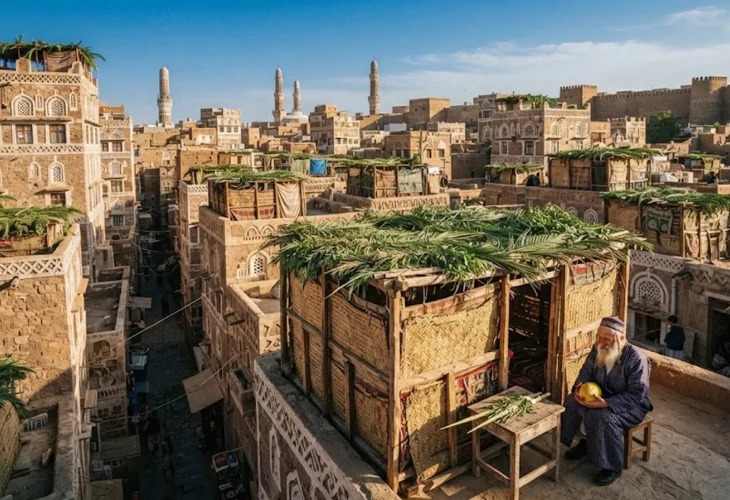
For centuries, Jewish communities flourished across the southern Arabian Peninsula, preserving traditions that developed under Yemen’s changing rulers and relative isolation from much of the wider Jewish world.
That isolation helped Yemenite Jews preserve distinctive prayer rites, Torah-reading traditions, and religious customs in remarkably ancient forms. Rabbi Yaakov Sapir, who visited Yemen in 1859, recorded many aspects of this world in his book Even Sapir, describing the synagogues, daily lives, and traditions of Yemenite Jewish communities.
Sukkot offered one of the most striking sights of all.
Sukkot Above the City
In old Yemeni cities such as Sana’a, Dhamar, Shara'b, and Sa'dah, houses were often built upward rather than outward. Constructed from stone and mud, many rose several stories high and were topped by flat roofs that formed an important part of everyday family life.
With narrow streets and little open space beside the houses, those rooftops also provided the natural place to build a sukkah.
As Sukkot approached, the roofs above the ancient city would be transformed. Temporary walls and s'chach appeared above the multistory homes, and families spent the seven days of the holiday in their rooftop sukkot. Sapir describes the architecture of Yemenite homes and the importance of their rooftops, a feature also documented by later scholars of Yemenite Jewish life.
The sukkah itself was generally simple. Rather than emphasizing elaborate decorations, families focused primarily on fulfilling the halachic requirements of the mitzvah. Walls could be constructed from whatever suitable materials were available, including mats, wooden beams, and temporary partitions.
The s'chach similarly reflected the local landscape. Jews used branches from trees available in their particular region, including acacia, Christ’s thorn jujube, and other local species. In Aden, where palm trees were plentiful, palm branches could be used as well.
The Famous Yemenite Etrog
Perhaps no Yemenite Sukkot tradition is more recognizable today than the Yemenite etrog.
For generations, Yemenite Jews cultivated their own local variety. Its appearance can be dramatically different from many of the etrogim commonly seen today: Yemenite etrogim can grow exceptionally large and are known for their thick rind and substantial inner flesh.
Their distinctive characteristics eventually became the subject of halachic discussion. When Yemenite Jews immigrated to the Land of Israel and brought their etrogim with them, rabbis examined the variety and discussed its lineage and traditional status.
For Yemenite Jews themselves, however, the most important evidence was their longstanding mesorah. These were the etrogim their communities had used for generations.
Rabbi Avraham Yitzchak HaKohen Kook, the first Ashkenazi Chief Rabbi of the Land of Israel, was among the prominent rabbis who discussed the Yemenite etrog and the significance of the tradition surrounding it. Over time, the variety gained followers outside the Yemenite community as well, and today Yemenite etrogim are used by Jews from a number of different backgrounds.
A Distinctive Way of Taking the Four Species
The other species could present a different challenge. Not every one of the Four Species grew readily in every part of Yemen, meaning that lulavim and hadassim sometimes had to travel considerable distances before reaching Jewish communities.
Yemenite Jews were meticulous about the appearance and condition of the Four Species. One of their most visually distinctive customs is the use of a generous number of hadassim around the lulav, rather than limiting the bundle to the minimum number required by halacha.
Yemenite halachic tradition was also deeply shaped by the Rambam, whose rulings occupied an especially important place in Yemenite Jewish life. Rabbi Yosef Kapach, one of the foremost modern scholars of Yemenite Jewish tradition and a renowned commentator on the Rambam, documented many of these longstanding practices concerning the Four Species and the laws of Sukkot.
Together, these customs offer a glimpse into a Jewish community that preserved its traditions for centuries in a remarkably distinctive environment. A sukkah rising above the rooftops of Sana’a, a huge Yemenite etrog, and a lulav surrounded by abundant hadassim were not simply picturesque features of the holiday. They reflected a community determined to fulfill the mitzvot of Sukkot according to the traditions handed down from generation to generation.

