

Sukkot
Why Is Hoshana Rabbah the Seventh Day? The Maharal Explains
Seven days, seventy bulls, seven circuits, and then an eighth day. Discover the Maharal’s fascinating explanation of the numbers behind Sukkot and Hoshana Rabbah.
- Yehosef Yaavetz
- | Updated
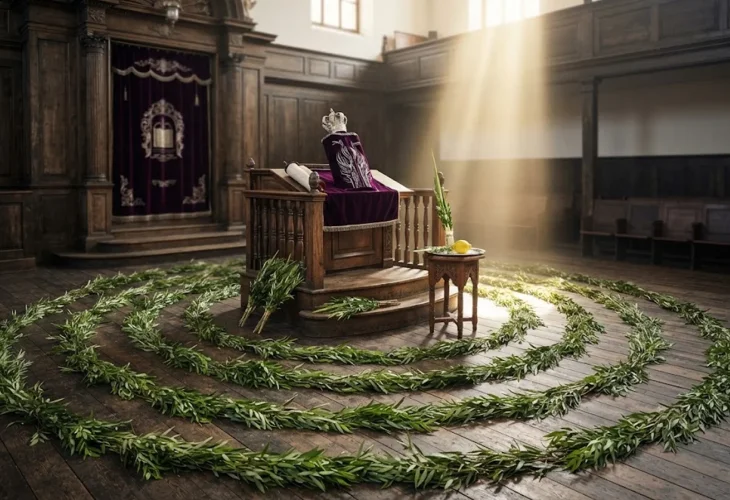
Hoshana Rabbah, the seventh day of Sukkot, has always held a special place within the festival. In the time of the Beit Hamikdash, the altar was circled once on each day of Sukkot. On the seventh day, however, it was circled seven times. The day is also associated with the special custom involving aravot, willow branches.
Why does the number seven appear so prominently on Hoshana Rabbah?
The Maharal develops a fascinating framework for understanding the numbers seven and eight. Seven, he explains, represents the natural world as Hashem created it. Eight represents something beyond that natural order.
Seen through this lens, Hoshana Rabbah becomes a day standing at a remarkable threshold: the completion of seven, just before we enter eight.
Why Seven Represents the Natural World
In Netzach Yisrael, the Maharal explains that seven is deeply connected to the structure of this world:
“For the level of this world is only the level of the number seven... and you find the number seven everywhere in connection with multiplicity.”
The world was created within a seven-day framework, and the number seven therefore represents the natural order of creation, with all its different forces, directions, nations, and dimensions.
Eight represents something different.
The Maharal explains that the Messianic era belongs to a level beyond the ordinary structure of this world:
“But the days of the Messiah are a level beyond this. For in the days of the Messiah, the multiplicity that exists in this world will be unified through the Messiah, and therefore the harp has eight strings.”
Seven represents a world containing many separate parts. Eight points toward a higher unity.
That distinction helps explain the progression from the seven days of Sukkot to Shemini Atzeret, the eighth day.
Hoshana Rabbah is still part of the seven. But it is the final day of seven, the moment when that entire structure reaches completion.
From Seventy Bulls to One
The Maharal connects this idea to the sacrifices brought during Sukkot.
Over the seven days of the festival, a total of seventy bulls were offered, corresponding to the seventy nations. The number decreased each day: thirteen on the first day, twelve on the second, continuing until seven were offered on the seventh day.
The Maharal writes:
“They sacrificed seventy bulls corresponding to the nations, for among the nations there is no unity, only multiplicity... Therefore, they offered seventy bulls over the seven days of Sukkot, because seven and seventy are similar and equivalent.”
The seventy bulls correspond to the nations of the world, reflecting the multiplicity represented by seven.
Then comes Shemini Atzeret.
“After the seven, they sacrifice one bull... corresponding to the one Jewish nation,” the Maharal explains.
The contrast is striking: seventy and one. Multiplicity and unity. Seven and eight.
This also gives greater meaning to the unique service of Hoshana Rabbah. The day remains part of the seven-day framework, yet it represents its culmination. During the first six days of Sukkot, the altar was circled once each day. On the seventh, it was circled seven times.
Seven reaches its fullest expression before giving way to eight.
What Does This Have to Do With Redemption?
The Maharal takes the idea even further by connecting the transition from seven to eight with the future redemption.
He cites the teaching of the Sages: “In the seventh year there will be wars. At the end of the seventh year, the son of David will come.”
Why specifically at the end of the seventh?
The Maharal explains that the seventh represents the completion of the existing natural order. The level associated with Mashiach, however, belongs to what comes afterward.
“Only the number that comes after seven is fitting for the Messiah,” he writes.
In the Maharal’s framework, redemption represents a movement from fragmentation toward unity. The world of seven contains multiplicity, while the level beyond seven points toward a reality in which that multiplicity is brought together.
This is why Hoshana Rabbah occupies such a distinctive place.
We are still within seven, but we have reached its edge.
Throughout Sukkot, we encounter symbols of multiplicity again and again: the Four Species, the seven days, the seventy bulls, and the circuits around the altar. On Hoshana Rabbah, the seven-day structure reaches its completion.
And then comes Shemini Atzeret, the eighth day.
The Maharal describes eight as representing “the unity that stands in contrast to these seven, which contain multiplicity.”
In this sense, Hoshana Rabbah can be understood as a day on the threshold. We are still within the natural order represented by seven, but already approaching the unity represented by eight.
The Maharal writes that the perfection of this world lies in the fullness of its multiplicity. In the future, however, “the multiplicity that exists in this world will be unified through the Messiah.”
That gives the final day of Sukkot an especially powerful meaning.
Seven days reach their completion. Seven circuits are made. The world of multiplicity reaches its fullest expression.
And once seven is complete, the path opens toward eight: toward unity, Shemini Atzeret, and what the Maharal describes as a divine level beyond the ordinary order of nature.
Perhaps that is one way to understand the spiritual power of Hoshana Rabbah: we stand at the very edge of seven, looking toward eight.
Sources: Maharal, Netzach Yisrael, chapter 32; Gevurot Hashem, chapter 47.

