

Magazine
From a Million-Dollar Shabbat to The Little Tichel Lady
Jessica Hayam's journey from a teenager determined to keep Shabbat against her family's wishes to the founder of a business helping Jewish women discover the beauty of covering their hair.
- Shira Dabush
- | Updated
 Jessica Hayam with her husband, David Nissim, and their children
She was only 14 when she found herself facing a choice that many girls her age never have to make: her parents and siblings were getting ready to leave for a Shabbat meal at relatives’ home, but she had decided that she would not violate Shabbat, even if it meant staying home alone.
Every Friday evening, the same ritual played out. “Every Shabbat night that I stayed home alone ended in tears,” Jessica recalls. “My family didn’t exactly accept it. As far as my parents were concerned, it was embarrassing that their daughter wasn’t coming to the Shabbat meal with all the relatives.” But even then, Jessica stood her ground. Despite the difficulty, she knew she wasn't going to give up Shabbat.
One evening, just before the family was due to leave the house, one of her parents tried an unusual approach to persuading her: “I’ll give you a million dollars if you come with us tonight,” they told her.
She knew they weren't serious, but even if they had been, it wouldn't have made much difference. “I remember thinking to myself that keeping Shabbat was worth more than a million dollars, so I stayed home again.”
More than two decades have passed since that evening, but the memory has stayed with her. Whenever she thinks back to it, she cannot help smiling at the thought that she refused to let anything come between her and Shabbat.
Today, Jessica Hayam is 39, married to David Nissim Hayam, and a mother of four. She lives in Los Angeles, the city where she grew up.
When I ask about the home in which she was raised, Jessica explains that hers was a traditional Jewish household. “But my parents chose to send us to Orthodox schools,” she says with a smile.
It was there that she first discovered the power of Shabbat. The Haredi way of life gradually captured the young girl's heart, even as the rest of her family continued to live much as before.
But that would not last.
“At a certain point, the whole household became more religious,” Jessica recalls. “My brother became religious, and my sister, although she isn’t Haredi, keeps kosher in her home so that we can all get together and eat as a family. Even my parents are no longer where they once were. Sometimes, when I hear one of them tell my little boy, ‘That’s muktzeh,’ I’m amazed by how far we’ve come together.”
What touched you most and left a lasting impression on you at the school you attended?
“In one of our Bible classes, we learned about the signs of kosher animals, and for me, it was about much more than a discussion of the laws of forbidden foods.
“I remember that we discussed the signs of kosher animals, and I thought to myself: ‘It can’t be that thousands of years ago, people knew all the animals that exist in the world.’ If the Torah tells us which animals are kosher and which are not, I felt that this showed it must come from a divine source, from Hashem. Otherwise, it would be possible to disprove it.”
That realization awakened in her a desire not merely to learn about the Torah, but to live by it. It was the first seed of a transformation that would gradually shape her life.
Her first step was to take on the practice of waiting between eating meat and dairy. “That meant we couldn’t eat dairy desserts after the Shabbat meal, and luckily, pareve options were already available, so the family simply switched to pareve desserts. It wasn’t a problem.”
Later, she stopped eating non-kosher food outside the home. “To maintain my connection with my family, I remember that at first I would go out to non-kosher restaurants with my relatives and order dairy or vegetarian dishes. But at a certain point, I stopped doing that. Even if I occasionally still went to restaurants that didn’t meet the level of kashrut I observed, I respected them and showed up, but I didn’t touch anything.”
While the family managed to find practical solutions when it came to kashrut, Shabbat observance presented a much greater challenge. Jessica was no longer willing to join her family on car rides, and the social and emotional cost of her decision was considerable.
“I knew that if I chose a wig, I wouldn’t wear something simple”
Despite the difficulties, Jessica emphasizes that she encountered people along the way who helped her build her spiritual world. “I believe that Hashem brings exactly the people we need into our lives at the time we need them, and that’s what happened to me.”
When she began attending NCSY, a Jewish youth organization, it became an important part of her life. For the first time, she had the opportunity to meet other young people who, like her, were looking to develop a deeper, more personal connection with Judaism.
What did that give you?
“For girls at that age, it’s very difficult to become more religious on your own if you don’t come from the right background. That framework helped me build my relationship with Hashem. I remember talking to Him all the time, both through the prayers in the siddur and simply through conversation. Talking to Him helped me get through difficult periods in my life and continue on my journey.”
Her desire to study in Israel was another part of that journey. After graduating from high school, she wanted to come to Israel, but her parents were not ready to let her go just yet. She had to wait until she had completed her college studies and become more financially independent.
Eventually, she made it to Israel, where she made another decision that would prove far more significant than she could have imagined at the time. It concerned the kind of head covering she would wear after marriage.
“At school, we were taught that there is a difference between being attractive and being attracting, between looking beautiful and appealing and drawing attention. For years, I didn’t really understand the difference.”
She says that it was only during her time in Israel, following a brief encounter with a woman whose face she can no longer remember, that she began to understand what that distinction meant to her.
“I’ve always loved beauty and aesthetics, and I didn’t want to give them up. But I knew myself, and I knew that if I wore a wig, I would probably choose one that attracted a lot of attention. Because of that, I didn’t want to put myself in that situation, and I didn’t want to place a stumbling block before others. So I decided that when I got married, I would wear a headscarf.”
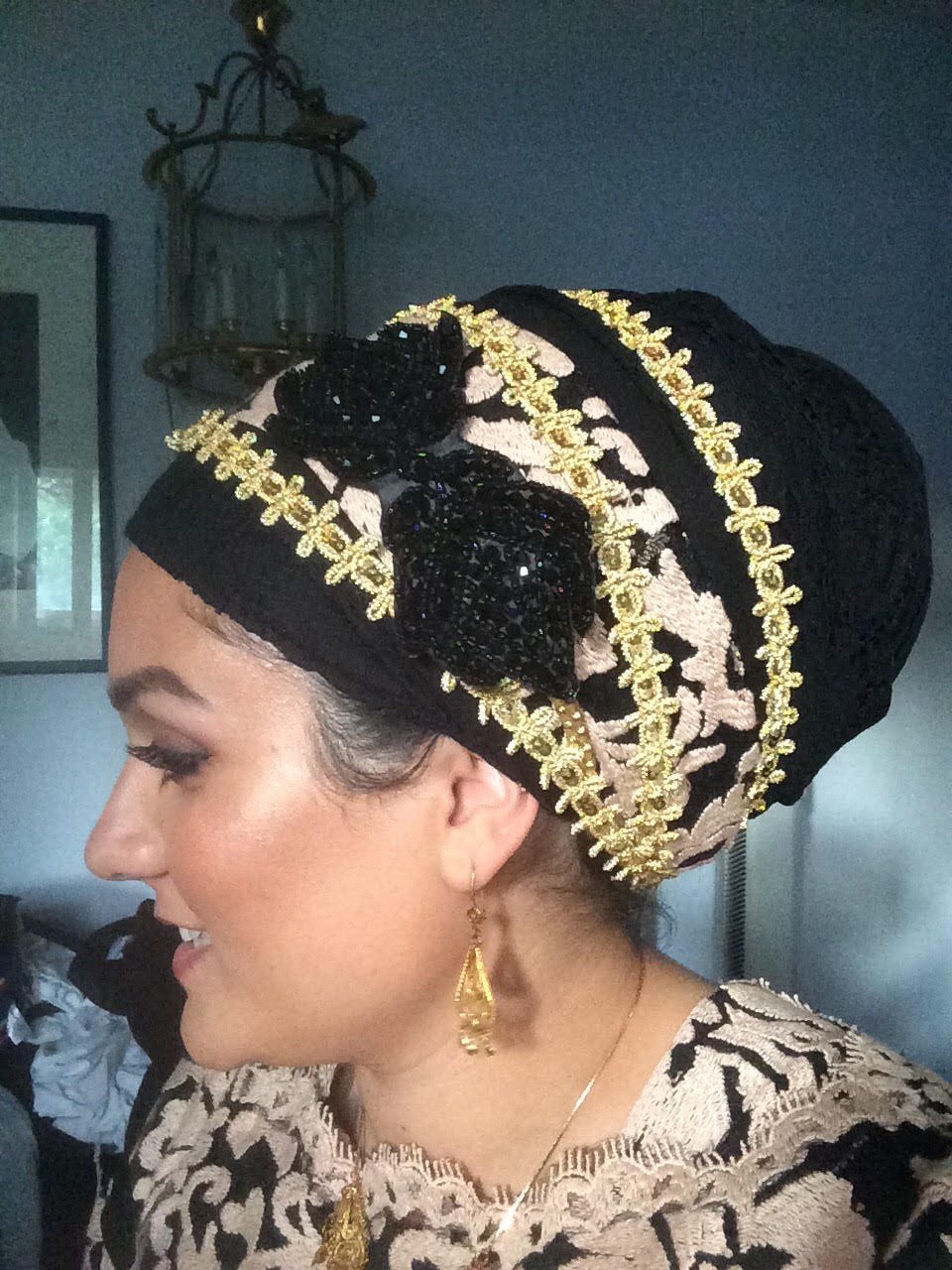 Jessica Hayam in one of her signature tichels
At the time, she had no idea just how significant that decision would become.
She met her husband, David Nissim Hayam, through mutual friends. But unlike the matchmaking stories in which couples immediately sense that they have found the right person, their story began rather differently.
“Funnily enough, neither of us was really the other’s type,” she says.
The match was suggested by a close friend of David Nissim's, who was married to one of Jessica's close friends.
“He was probably the only person who could have convinced both of us to agree to go out,” she says with a smile. “When people talk about meeting the right person at the right time, they should remember that the matchmaker can also come from somewhere unexpected. Hashem is in charge of these things.”
“I kept going because I had no reason to say no.”
According to Jessica, the match was far from what she had imagined. Even after they began dating, there was no immediate romantic spark. Instead, their relationship developed gradually, one date at a time.
“On every date, I simply had no reason to say no, so I continued.”
It was only on their eighth date that she first realized she could genuinely imagine spending her life with him.
“I loved learning Torah, and I wanted to marry someone who loved learning. I wanted someone who was confident in himself and in his Judaism. It was important to me that when we had children, we wouldn’t simply tell them what to do, but would explain why we did things.”
After the wedding, Jessica began covering her hair with a headscarf, as she had decided she would back in Israel. But she soon discovered that making the transition was not as easy as she had expected.
“I didn’t feel comfortable with anything I put on my head,” she explains. “The change was too dramatic and extreme for me, and it wasn’t as simple as I had imagined. I wanted to feel as beautiful as I had before, but I didn’t connect with the tying styles I knew.”
She began experimenting with different ways of tying her scarves.
“I would play around with different styles when I knew I was at home and no one would see me. That way, I could figure out what I liked and what I didn’t.”
About a month after the wedding, the couple traveled to Israel. Jessica took the opportunity to stock up on headscarves, since the selection available in the United States was more limited at the time.
“For a few weddings, I even sent fabric from my dress to a designer in Israel, and she made a matching head covering for me.”
Out of this personal need grew The Little Tichel Lady, a brand specializing in headscarves and women's hair coverings.
Were there any challenges in setting up a business like this? After all, you didn’t have many competitors back then.
“Of course. The biggest challenge was the fear that women wouldn’t connect with the styles we sold and that the merchandise wouldn’t sell. At the time, getting stuck with inventory that nobody wanted would have been a real problem.”
Those fears began to subside when large numbers of women from the local community turned up for the grand opening.
“Suddenly, we felt that we were really offering something that had been missing.”
“She can feel beautiful in a new way”
Her husband, David Nissim, supports her with the technical side of the business. He helps organize events, attach price tags, manage inventory, and take care of the practical tasks involved in running the business.
But as the business grew, Jessica realized that she was doing more than simply selling headscarves.
She meets women for whom covering their hair is part of a personal and emotional journey, and sometimes a significant spiritual step as well.
“We meet Ashkenazi women who don’t have access to the internet and who have decided to switch to covering their hair with a headscarf. I teach them how to tie the scarves, and it helps them a lot. There are also women who have chosen to replace their wigs with headscarves as a personal commitment they have taken upon themselves in the hope of a salvation.”
That sounds moving.
“Yes, it is moving, but what is even more moving is the change I see on a woman’s face when she suddenly discovers that she can feel beautiful in a new way.
“When I teach a woman face-to-face how to tie a headscarf in several different ways, I can actually see her confidence change. She leaves here knowing that she can wear her headscarf proudly.”
More recently, Jessica expanded her work with the launch of a podcast, Under Wraps with Jessica, dedicated to the personal stories of women who have chosen to cover their hair with a headscarf.
How did the idea come about?
“The idea had been developing in my mind for two years. I wanted to create a podcast, but I didn’t want to make something meaningless without a purpose. The trigger that led me to choose this particular subject was a visit to Israel, where I asked one of the designers why she had chosen to cover her hair with a headscarf.
“Her story was so interesting and fascinating that I found myself continuing to ‘interview’ other women about the stories behind their head coverings. So many women had incredible stories that, little by little, I developed a feeling that I had chosen the right subject. I wanted to give these stories a place.”
And so the podcast was born. Through it, Jessica seeks to get to know the women behind the head coverings: the choices they have made and the struggles that are not always visible to others.
Some of the stories have surprised her, too.
“Several women told me that when they wore wigs, they felt they weren’t being true to themselves. It was as if they were dressing up as someone else. The headscarf, by contrast, made them feel most like themselves.”
Another woman explained that covering her hair was a way for her to reserve part of her beauty for her husband.
“It taught me that you can’t know what someone is going through just by looking at them from the outside,” she says. “We don’t know what their struggles are, and we don’t know what their strengths are, either.”
“Through the headscarves I design and the stories I collect, I hope to remind women that covering their hair does not hide who they are. On the contrary, it can help them discover themselves anew.”
 Beginners GuideWhy Cover My Hair If It “Ruins” My Look? 3 Surprising Reasons
 MagazineFrom Sabich Shop to Spiritual Journey: The Inspiring Story of Chef Itay Aricha
 MagazineFrom Professional Soccer to Torah Life: The Inspiring Journey of Idan Tal
 MagazineMeet the Orthodox Jewish Woman Who Became a Millionaire Before 30

