

History and Archaeology
Haifa’s Forgotten Jewish History: A Center of Torah Before the Crusades
Discover how medieval Haifa became a center of Jewish religious leadership in 1082, before its thriving Jewish community was devastated during the Crusader conquest of 1100
- Yosef Yaavetz
- | Updated
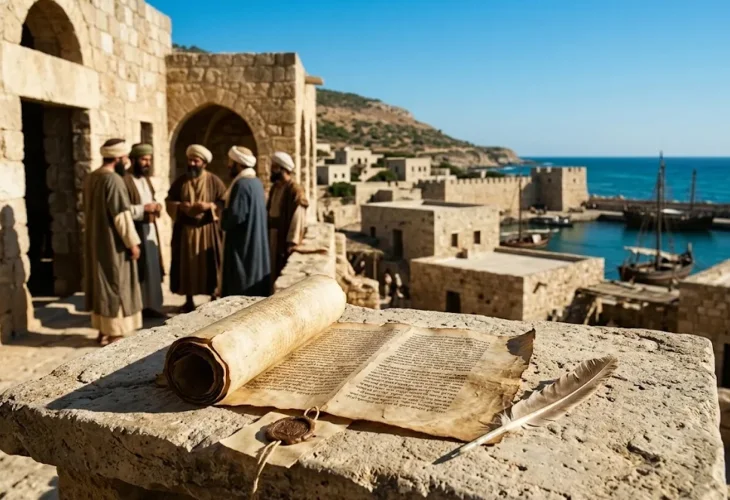
In the autumn of 1082, Rabbi Eliyahu HaKohen Gaon arrived in Haifa. Behind him lay decades of leadership of the Land of Israel's great yeshiva, displacement from Jerusalem, years of warfare, and challenges to his authority. Before him stood a Jewish community in a fortified coastal town at the foot of Mount Carmel. It was here that he sought to hold a public gathering that would reaffirm the continuity of Jewish religious leadership in the Land of Israel, renew the office of Gaon and the institution of semichah, and formally establish the yeshiva's leadership before the community.
His son, Rabbi Evyatar, preserved the occasion in a remarkable account: "He went to Haifa to sanctify the year and renewed the Gaonate and the semichah in Haifa, at the House of Assembly." These words, preserved in the Cairo Genizah, offer a rare glimpse into an extraordinary chapter of Haifa's history, when the coastal town became a gathering place for the leading Torah scholars of the Land of Israel and played a significant role in the struggle to preserve their religious authority.
Haifa Before the Modern City
To imagine Haifa in the eleventh century, one must look beyond its modern port, hillside neighborhoods, and bustling streets. Medieval Haifa was a relatively small coastal settlement near the slopes of Mount Carmel, protected by fortifications that surrounded its inhabitants and harbor, in the vicinity of present-day Bat Galim. Although neighboring Acre was a more prominent commercial center, Haifa maintained its own trading activities, local industries, and maritime connections.
The city was also known for shipbuilding. In 1047, the Persian traveler Nasir Khusraw passed through Haifa and described the construction of a particular type of vessel he called a judi, offering evidence of the town's maritime industry and economic capabilities. It was this fortified coastal settlement that Rabbi Eliyahu HaKohen chose as the setting for an event of considerable religious and historical importance.
A Yeshiva Forced Into Exile
Rabbi Eliyahu HaKohen ben Shlomo assumed the position of Gaon in 1062, following many years of involvement in the prestigious Yeshivat Gaon Yaakov, the central yeshiva of the Land of Israel. His association with its leadership stretched back decades. A document from Damascus dated 1031 identifies him as a member of the "Great Sanhedrin," the title used for the central rabbinical court of the Land of Israel.
His tenure coincided with a period of severe political instability. Conflicts involving the Fatimids and Turkish and Seljuk forces transformed the region's political landscape, undermining security and disrupting Jewish communities. As conditions deteriorated, the yeshiva was forced to leave Jerusalem and relocate to Tyre, a fortified port city in present-day Lebanon. By 1079, its presence there was documented.
Tyre offered relative security and a degree of political independence, allowing the yeshiva to continue operating near the Land of Israel. Yet the relocation created a fundamental problem concerning its authority. The institution's standing rested on its identity as the central rabbinical court of the Land of Israel, but it was now operating beyond the country's halachic boundaries. This distinction was particularly significant because the authority to intercalate the Jewish calendar was traditionally associated with the Land of Israel. How could an institution based in Tyre continue exercising the authority of the great court of the Land of Israel?
Rabbi Eliyahu concluded that despite the dangers posed by ongoing warfare, the yeshiva and its rabbinical court needed to reestablish their authority within the Land of Israel itself. He chose Haifa, whose fortified position offered a measure of protection while allowing the institution to reaffirm its connection to the land.
The Historic Gathering of 1082
The events surrounding the renewal of the Gaonate are described in Megillat Evyatar, an account written by Rabbi Eliyahu's son. According to the document, Rabbi Eliyahu first gathered members of the community from Tyre and the Galilee and arranged the succession of leadership within the yeshiva. His son Rabbi Evyatar, who had served as head of the rabbinical court, was elevated to the position of Gaon, while another son, Rabbi Shlomo HaKohen, was appointed head of the court. Other officials were similarly advanced within the institution's hierarchy.
The following year, on Hoshana Rabbah of 4843, in the autumn of 1082, the formal renewal ceremony took place in Haifa. Rabbi Evyatar describes the arrival of the yeshiva's leadership from Tyre, the participation of its scholars, and the presence of the wider community. The appointments were publicly reaffirmed, and the institution's authority was formally renewed. He emphasized that the proceedings took place "before all Israel," describing the restoration of the semichah, the House of Assembly, and the Great Sanhedrin.
The public nature of the gathering was essential. It demonstrated that the yeshiva's authority remained rooted in the Land of Israel, despite the temporary displacement of its scholars and leadership.
Following the ceremony, Rabbi Eliyahu returned to Tyre to arrange the yeshiva's eventual relocation once the fighting subsided. However, only a few months later, he died in the city. Megillat Evyatar describes the remarkable funeral procession that carried his body from Tyre to Dalton in the Galilee, a journey lasting three days. Mourners carried him on their shoulders, and he was buried at a site traditionally associated with the graves of the sages of the Galilee. In death, the Gaon was returned to the land with which his life's work had been so closely connected.
A Struggle for Religious Authority
The importance of the Haifa gathering became even clearer in the years that followed. David ben Daniel, the son of an earlier Gaon, Rabbi Daniel ben Azariah, established himself in Egypt and began claiming extensive religious authority. His challenge raised a difficult question: If Rabbi Eliyahu could serve as Gaon while residing in Tyre, why could David ben Daniel not claim similar authority from Cairo?
Rabbi Evyatar composed his account partly to address this dispute. By documenting the public renewal of the Gaonate in Haifa, he sought to demonstrate that his father's authority had not rested solely on his position in Tyre. Rather, it had been formally reaffirmed within the Land of Israel, in the presence of its elders and scholars, together with the appointments of the other leaders of Yeshivat Gaon Yaakov.
After his father's death, Rabbi Evyatar continued to lead the institution and defend its authority. His account, believed to have been composed around 1094, preserved the details of the Haifa gathering and the succession of appointments. A copy survives today in the Taylor-Schechter Collection at Cambridge University Library.
Haifa's Jewish Community Faces the Crusaders
Less than twenty years after the historic gathering, Haifa's Jewish community faced a far more devastating threat. In 1099, the Crusaders captured Jerusalem. By the summer of 1100, their military campaign had turned toward Haifa, which remained a fortified coastal town inhabited by Jews and defended by a Muslim garrison.
Control of the coastal cities was essential to the Crusaders' military and economic ambitions. Their forces depended on maritime supply routes, access to ports, and connections with European fleets. Capturing Haifa would strengthen their hold over the coastline and facilitate cooperation between the Crusader armies and Italian naval forces.
The assault on Haifa combined a land force commanded by Tancred with Venetian ships approaching from the sea. The city came under attack from both directions, with the fleet restricting access by water while the land forces advanced against its fortifications. Jewish residents and the Egyptian garrison mounted a determined defense that lasted nearly a month. The attackers constructed a siege tower and employed siege engines built by Venetian craftsmen, who used timber from their vessels. Their maritime construction skills were redirected toward breaching the city's defenses.
Eventually, Haifa fell. Historical accounts describe widespread killing and the destruction of the Jewish community. The prolonged resistance was overcome, and the city became part of the Crusader-controlled coastal territory.
The Legacy of a Vanished Community
When the Jewish traveler Benjamin of Tudela passed through the region in the twelfth century, he mentioned Haifa, Mount Carmel, and Jewish burial sites. Unlike many other places he visited, however, he did not record the presence of an established Jewish community in the city. His silence, together with accounts of the Crusader conquest, reflects the devastation that had overtaken Haifa's Jewish population and the broader institutions of Jewish religious leadership in the Land of Israel.
Yet the events of 1082 had not disappeared entirely. Through Megillat Evyatar, preserved among the treasures of the Cairo Genizah, the memory of Haifa's brief but significant role in Jewish religious history survived.
Long before Haifa became a modern port city, its fortified walls had witnessed a gathering of Torah scholars determined to preserve the continuity of Jewish leadership in the Land of Israel. Though the community itself would soon face destruction, the record of that gathering endured, preserving the story of a city that briefly stood at the center of a struggle for the future of Jewish religious authority.
 History and ArchaeologyAncient Innovations: How the Israelites Made the Land of Israel Flourish
 History and ArchaeologyThe Mystery of Ramban’s Burial Place
 History and ArchaeologyA Plot Against the Pope: The Extraordinary Story of Alexander Ziskind
 History and ArchaeologyWhat Mark Twain Saw: His Remarkable Journey to the Holy Land

