Home Styling
How to Organize a Kosher Kitchen: Simple Tips for Beginners
Discover practical tips for keeping a kosher kitchen organized, avoiding mix-ups, and making everyday cooking easier
- Naama Green
- | Updated
I remember the first week after we koshered our kitchen as though it were yesterday. I stood in front of a drawer, holding a teaspoon, while my coffee with milk slowly grew cold. I couldn't remember which side of the kitchen I had taken the spoon from. For the third time that day, I called our rabbi and apologized for bothering him. I could hear the smile in his voice as he reassured me that questions from beginners were his favorite part of the job.
I continued learning the halachot of keeping kosher, but I also realized that I needed a better system. Gradually, a few small organizational habits transformed my kitchen from a source of constant uncertainty into a place where I could feel comfortable and confident.
Start With a Clear Division Between Meat and Dairy
Our Sages teach, "If you grasp too much, you grasp nothing; if you grasp a little, you grasp something" (Rosh Hashanah 4b). I took that advice to heart and began with something simple: dividing the kitchen into two distinct areas.
I placed all the meat utensils in the cabinets on the left side of the kitchen, near the stove. Dairy mugs and teaspoons went into the cabinets on the right, close to the kettle, where we prepared coffee and oatmeal. I attached small labels to the cabinet doors identifying their contents: "Meat Pots" and "Dairy Mugs." Those labels stayed in place for several months, until everyone in the family became familiar enough with the arrangement that they no longer needed to check them.
Use Colors to Prevent Confusion
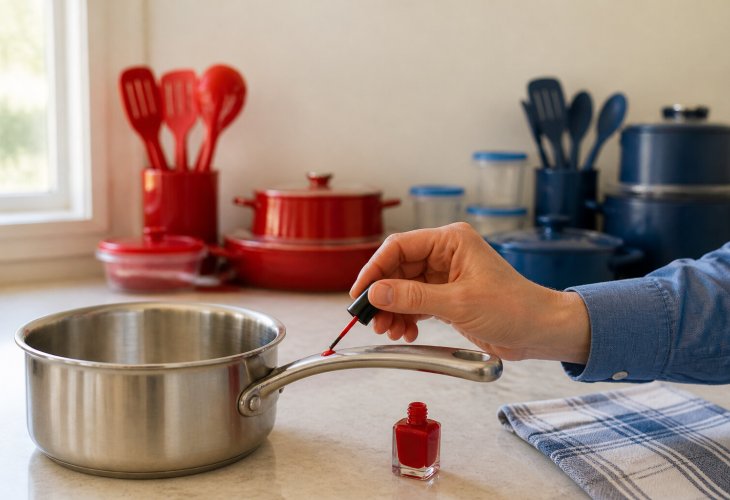
As long as the utensils remained in their designated cabinets, it was easy to tell which were meat and which were dairy. But once they reached the countertop, things became more complicated. That's when I introduced a color-coding system: red for meat, blue for dairy, and green for pareve.
At first, I marked only the pots and plates. Within two days, however, I discovered that the real confusion involved lids, teaspoons, ladles, and frying pans. Today, whenever someone tells me they're organizing a newly kosher kitchen, I recommend setting aside an evening to mark every utensil with a small dot of nail polish, including baking trays and cups. For pots and pans, it's best to place the mark on the handle rather than the bottom, which comes into direct contact with the heat. The polish generally holds up well through repeated washing, although it may need occasional touch-ups. When purchasing new utensils, choosing easily distinguishable colors can make the system even simpler.
I extended the color coding to sponges and kitchen towels. Red sponges were reserved for meat dishes, blue for dairy, with matching towels for each category. I made a point of buying replacement sponges in those same colors, even when other colors were on sale. If there's no room for two dish-drying racks, two separate trays in different colors can serve the same purpose.
Keep a Separate Set of Pareve Utensils
One of the most useful decisions I made was setting aside a pot, knife, and cutting board exclusively for pareve food. There were countless occasions when the meat pot was sitting dirty in the sink and the dairy pot was already in use. Having a separate pareve pot meant I could still prepare rice or vegetables without rearranging the entire kitchen.
During those early months, when I was still learning which utensils belonged where, my pareve equipment became a dependable part of the kitchen routine.
Label Everything in the Refrigerator
I soon discovered that organization didn't end with the dishes. Food containers presented their own challenges. Tomato sauce cooked with meatballs can look remarkably similar to an ordinary pasta sauce the following day. To avoid confusion, I began placing a strip of masking tape on every container before putting it in the refrigerator. Each label identified the food inside and whether it was meat, dairy, or pareve.
I also designated one refrigerator shelf for dairy products and dishes. The labels and separate storage area made it easier for everyone to find what they needed without constantly asking questions. The refrigerator became more organized, and I became more confident.
Create a Place for Utensils That Need a Halachic Ruling
Perhaps the most important lesson I learned was that mistakes are inevitable, especially when you're just beginning to keep a kosher kitchen. Rather than panicking when something went wrong, I created a simple system for dealing with uncertainty.
In my pantry, I placed a box labeled "Waiting for an Answer." Whenever I wasn't sure about a utensil's kosher status, I put it in the box until I could consult our rabbi. That way, it wouldn't accidentally find its way back into regular use.
I also attached a short note describing what had happened. For example: "Used a dairy spoon to stir hot chicken soup." Having the details written down made it much easier to explain the situation accurately and receive the appropriate halachic guidance.
Keep Your Rabbi's Number Handy
I also posted our rabbi's telephone number on the refrigerator, right next to the grocery list. During those first few weeks, I probably called him more often than I called my mother.
Looking back, I realize how much of my initial anxiety came from trying to remember everything at once. Learning the laws was essential, but creating consistent routines made them easier to put into practice.
Six years later, the box labeled "Waiting for an Answer" sits empty for most of the month. The cabinet labels are long gone, and the color-coded utensils have become second nature.
A kosher kitchen doesn't become organized overnight. But with a little patience, clear labels, and a few dependable habits, what initially feels overwhelming can gradually become a natural part of everyday life.