Wonders of Creation
The Sahara Silver Ant: A Tiny Creature With Extraordinary Survival Abilities
Discover how the Sahara silver ant withstands scorching temperatures with its reflective silver hairs, incredible speed, and natural cooling mechanisms—and how its extraordinary adaptations are inspiring new technologies
- Yosef Yaavetz
- | Updated
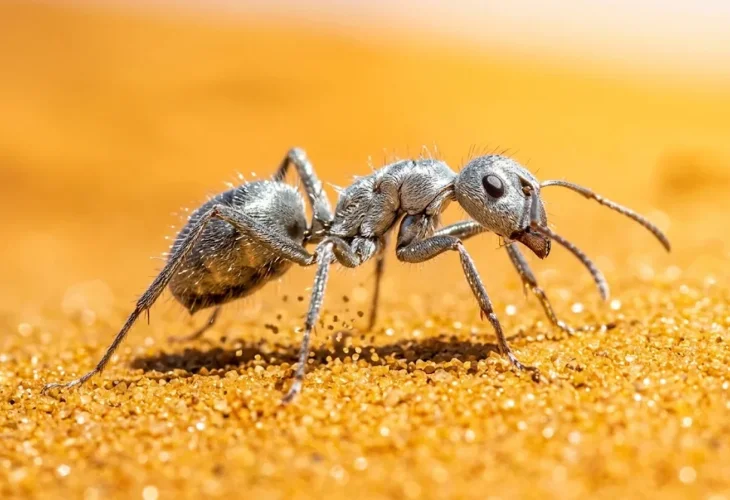
At midday, when the scorching desert sand reaches temperatures exceeding 60°C (140°F) and sometimes approaches 70°C (158°F), most animals retreat into the shade. Yet at precisely these extreme temperatures, a tiny silver-colored ant, measuring approximately one centimeter in length, emerges from its nest and races across the exposed sand in search of food.
Known as the Sahara silver ant, this extraordinary insect is considered one of the most heat-tolerant land animals on Earth. Its critical body temperature has been measured at approximately 53.6°C (128.5°F), allowing it to remain active even when the ground beneath it is considerably hotter.
The ant feeds partly on insects and other small creatures that have died or succumbed to the intense heat. Its predators, including desert lizards, have lower heat-tolerance limits and become less active during the hottest hours of the day. This creates a narrow window during which the ant can forage in the open, taking advantage of available food while facing a reduced threat from certain predators. To survive, however, it must keep its excursions remarkably short.
The Secret Behind Its Silver Coat
The Sahara silver ant's ability to withstand extreme temperatures begins with its unusual body covering. Although the ant appears silver in sunlight, its color does not come from ordinary pigmentation. Instead, its body is covered with a dense layer of microscopic hairs that reflect light in a highly specialized way. Under an electron microscope, researchers discovered that these tiny hairs have a triangular cross-section, with two of their surfaces featuring delicate grooves. This geometric arrangement influences how sunlight interacts with the ant's body, determining how much radiation is absorbed and how much is reflected.
In a 2015 study published in the journal Science, researchers examined the optical and thermal properties of these hairs and discovered that they perform two complementary functions. In visible and near-infrared wavelengths, they increase the reflection of incoming radiation, allowing much of the sun's energy to bounce away from the ant's body. At longer thermal infrared wavelengths, however, the hairs facilitate the efficient release of heat into the surroundings. Together, these properties create a passive temperature-regulation system that helps prevent the insect from overheating.
The cooling mechanism relies on a fundamental principle of physics: every warm object emits electromagnetic radiation. Humans, rocks, and ants all release thermal energy in this way. When the ant's body emits infrared radiation, heat escapes into the environment. Its microscopic hairs are structured to make this process particularly effective, helping the ant maintain a lower body temperature even under direct sunlight.
A separate optical study published in 2016 investigated the geometry of the hairs in greater detail. Using computer models and experiments measuring light reflection, researchers found that the hairs' triangular structure enables total internal reflection along one of their surfaces, while the tiny grooves further enhance their reflective properties. According to the study, the hair layer increased light reflection by nearly tenfold compared with a surface lacking this specialized structure. Ants whose hairs had been removed also heated up more quickly under sunlight.
What appears to the human eye as a beautiful silver sheen is therefore much more than a visual characteristic. It is a sophisticated optical and thermal system that helps the ant survive in one of the harshest environments on Earth.
Built to Stay Above the Heat
The ant's silver hairs are only one component of its remarkable cooling system. Its body structure also helps reduce exposure to the scorching desert floor. The Sahara silver ant has relatively long legs that elevate its body above the sand. Although the distance may seem insignificant, even a slight increase in height can make a meaningful difference in the desert, where the ground transfers heat through direct contact and emits intense thermal radiation. By keeping its body farther from the surface, the ant reduces its exposure to some of the heat rising from the sand.
Its extraordinary speed provides another crucial advantage. Research published in 2016 recorded Sahara silver ants reaching speeds of up to 855 millimeters per second. For an insect measuring less than a centimeter in length, that represents approximately 108 body lengths per second, placing it among the fastest ants measured by researchers.
Much of this speed comes from the structure of its legs and its highly efficient walking pattern. Scientists recorded an average stepping frequency of approximately 40 cycles per second at high speeds, with a maximum of around 47 cycles per second. Each foot can remain in contact with the ground for as little as seven milliseconds. During rapid movement, the ant employs a pattern known as a tripod gait, in which three legs support the body while the other three move forward. At certain moments during its running cycle, all six legs may briefly leave the ground.
This speed is more than an impressive athletic achievement. It is an essential part of the ant's temperature-management strategy. Every additional second spent on the scorching sand increases its exposure to heat, making rapid movement and brief foraging trips critical to survival.
Protecting the Body From Heat Damage
Even with its reflective hairs, elevated body position, and remarkable speed, the Sahara silver ant must still cope with the damaging effects of extreme temperatures at the cellular level. Proteins, which carry out many essential functions within living cells, are particularly sensitive to heat. When temperatures become too high, some proteins can lose their proper three-dimensional structure, potentially disrupting normal cellular activity.
Cells respond to this threat by producing specialized molecules known as heat shock proteins, or HSPs. Some function as molecular chaperones, helping other proteins maintain their correct structure or recover after heat-related damage. The Sahara silver ant possesses an abundance of these protective proteins, which may help its cells withstand and repair the effects of extreme temperatures. This cellular defense adds another layer of protection, complementing the ant's physical adaptations and behavior.
Finding Its Way Home in an Endless Desert
Surviving the heat is only part of the challenge. The Sahara silver ant must also locate food and return to its nest before prolonged exposure becomes dangerous. Its navigational abilities have fascinated researchers for decades. After leaving the nest, the ant may travel considerable distances across an environment that appears almost identical in every direction, with few obvious landmarks to guide its return.
Rather than wandering aimlessly, the ant uses an internal navigation system that continuously tracks its direction and distance from the starting point. This process, known as path integration, allows it to calculate a route back toward the nest. By using the sun's position as a directional reference while estimating the distance it has traveled, the ant can navigate efficiently and minimize the time spent searching for its way home. For an animal operating so close to its thermal limits, accurate navigation is an essential survival mechanism.
How the Sahara Silver Ant Is Inspiring New Technology
The unusual properties of the Sahara silver ant have attracted attention beyond biology. Engineers and materials scientists are studying its reflective hairs as a model for developing more effective cooling technologies through a process known as biomimicry, which involves drawing inspiration from biological structures to solve engineering challenges.
Researchers are investigating whether materials that imitate the geometry of the ant's hairs could be used to create surfaces that reflect incoming sunlight while efficiently releasing thermal radiation. Such technology could have applications in specialized coatings, building materials, and cooling systems designed to reduce heat accumulation without requiring additional energy. The ant's natural cooling mechanism demonstrates how carefully structured materials can regulate temperature through their physical properties alone.
An Extraordinary Example of the Wonders of Creation
The Sahara silver ant lives in an environment where even a small imbalance in body temperature can become life-threatening. It ventures out when the sand is at its hottest, exposes itself to intense solar radiation, and must complete its search for food within a narrow window of time. Yet nearly every aspect of its biology contributes to meeting these challenges.
Its microscopic hairs reflect sunlight and release heat, its long legs lift its body above the scorching ground, and its muscles and specialized movements allow it to run at astonishing speeds. Protective proteins help safeguard its cells, while its remarkable navigational abilities guide it back to safety before the heat becomes overwhelming.
Scientific research reveals this system at many different levels, from the geometry of a single microscopic hair to the behavior of the entire animal. It is the coordination of these adaptations that makes the Sahara silver ant one of nature's most fascinating creatures. What appears to be an ordinary insect is an extraordinary example of the wonders of creation, reflecting the remarkable ways in which Hashem has equipped living creatures to survive and obtain nourishment even under the most challenging conditions.