

History and Archaeology
Hidden for 2,000 Years: The Scrolls That Amazed Bible Scholars
What did two ancient scrolls, discovered centuries apart, reveal about the Bible? Their remarkable accuracy continues to astonish scholars and strengthen confidence in the Masorah.
- Yehosef Yaavetz
- | Updated
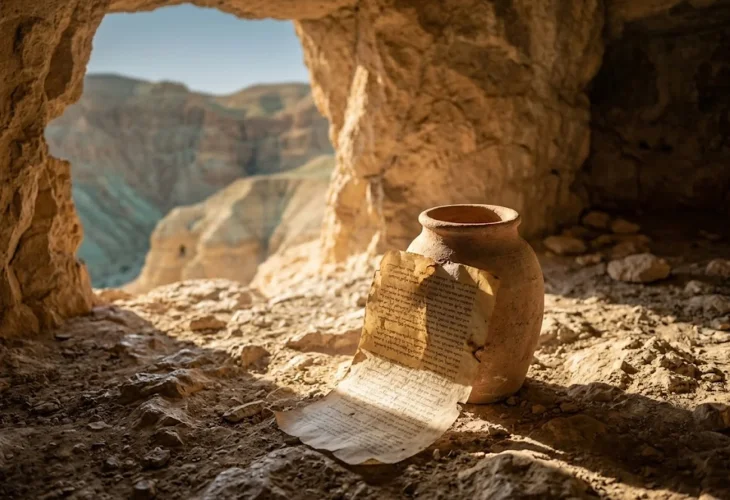
One of the greatest archaeological discoveries ever made was the complete Isaiah Scroll, found hidden inside a clay jar in a cave near the Dead Sea. Preserved for nearly 2,000 years, the scroll contains the entire Book of Isaiah, including the famous words, "Comfort, comfort My people," offering powerful evidence of how faithfully the biblical text has been transmitted throughout the generations.
The scroll survived the destruction of the Second Temple, the Great Revolt, the Bar Kokhba revolt, the rise and fall of empires, wars between Byzantines, Muslims, Crusaders, and Mongols, centuries of Ottoman rule, and was ultimately discovered in modern times.
Today, this remarkable manuscript is displayed at the Shrine of the Book in Jerusalem. Stretching more than 24 feet (7.3 meters) long, it allows visitors to read the Book of Isaiah from beginning to end, including its stirring message of hope:
"Comfort, comfort My people," says your Hashem. "Speak tenderly to Jerusalem and proclaim to her that her hard service has been completed, that her sin has been paid for."
A Discovery That Surprised Bible Scholars
Beyond its emotional and historical significance, the Isaiah Scroll also transformed biblical scholarship.
For many years, some scholars believed that the text of Isaiah had gradually changed through centuries of copying. They argued that the version preserved in Jewish tradition must have accumulated errors or undergone revisions over time.
The discovery of the Isaiah Scroll challenged that assumption.
Written more than 2,000 years ago, the scroll closely matches the Masoretic Text that has been faithfully preserved throughout the generations. Despite the passage of centuries, Jewish scribes copied the words of the prophets with extraordinary precision, preserving the text with remarkable accuracy.
Professor Emanuel Tov, one of the world's leading experts on the Dead Sea Scrolls, writes that manuscripts found at sites such as Masada, Nahal Hever, Nahal Ze'elim, and Murabba'at consistently reflect the Masoretic tradition. Comparing the Isaiah Scroll with the medieval Leningrad Codex, he found them to be virtually identical, differing only in a minor spelling variation.
He concluded that these manuscripts demonstrate an exceptionally careful tradition of transmission that preserved the biblical text with astonishing precision over many centuries.
For those who have always trusted the Masorah, however, this discovery simply confirmed what Jewish tradition has maintained all along—that the text of Scripture was transmitted with meticulous care, letter by letter.
The Burned Torah Scroll That Spoke Again
Another remarkable example comes from Ein Gedi.
In 1965, archaeologists excavating the remains of an ancient synagogue uncovered several charred parchment fragments inside the Holy Ark. Among them was a badly burned Torah scroll dating back to the period of the Tannaim.
The scroll was so fragile that it could not be opened without destroying it. Although researchers knew it was an ancient Torah scroll, there was no technology capable of revealing what it contained. For 46 years, it remained sealed—an extraordinary artifact whose words seemed lost forever.
Everything changed when archaeologist Pnina Shor of the Israel Antiquities Authority partnered with Professor Brent Seales of the University of Kentucky, a pioneer in the digital recovery of ancient manuscripts.
Using CT scanning and advanced computer imaging, researchers were able to "virtually unwrap" the scroll without physically opening it. Layer by layer, the hidden text was revealed on a computer screen, allowing the ancient scroll to be read for the first time in nearly 1,500 years.
Afterward, biblical scholars Professor Michael Segal of the Hebrew University and Professor Emanuel Tov carefully analyzed the recovered text.
Their conclusion was striking: the verses matched the Masoretic Text, both in their wording and in the traditional division of the passages.
Again and again, archaeological discoveries continue to testify to the extraordinary care with which the Jewish people preserved the Torah and the Prophets. Ancient manuscripts, hidden for centuries and uncovered in modern times, consistently bear witness to the remarkable precision of the Masorah and the faithfulness with which the biblical text has been transmitted from generation to generation.

