

Wonders of Creation
What Makes an Etrog So Different From Other Citrus Fruits?
Why is an etrog so thick, fragrant, and different from other citrus fruits? The answer begins with the remarkable biology hidden beneath its peel.
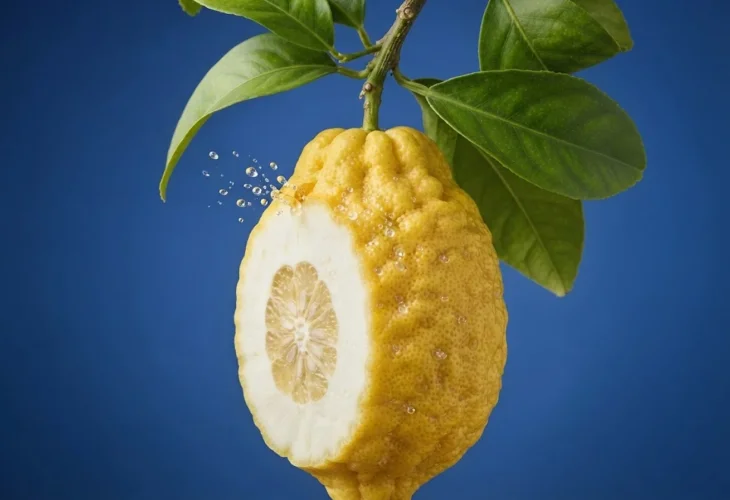
Bend a piece of orange peel near a flame and you may see tiny flashes. Rub it between your fingers and its unmistakable citrus scent immediately fills the air. What seems like a simple fruit peel is actually filled with microscopic reservoirs of essential oil. When those reservoirs burst, the oil can shoot through the air at astonishing speeds.
Researchers studying the mechanics of citrus peel used ultra-high-speed cameras to capture something our eyes normally miss. When citrus peel is bent or squeezed, pressure builds inside tiny oil-filled glands until they rupture, releasing microscopic jets of fragrant oil.
In experiments measuring hundreds of these jets, researchers recorded maximum speeds of approximately 29.65 meters per second, or about 67 miles per hour.
That means the tiny droplets you feel when squeezing an orange peel may have emerged from the fruit at roughly highway speed.
What Is Hiding Inside Citrus Peel?
Citrus essential oil is not simply sitting on the surface of the fruit. It is stored inside tiny glands embedded in the outer peel. When you peel, bend, crush, or rub the fruit, some of those reservoirs rupture and release their contents. That is why the citrus aroma becomes so much stronger when the peel is disturbed.
The process happens extraordinarily quickly. Using cameras capable of recording thousands of frames per second, researchers observed that in some cases less than 63 microseconds passed between rupture and the appearance of oil outside the peel.
The peel works almost like a tiny pressurized system. A tougher outer layer surrounds softer, more compressible tissue containing the oil reservoirs. When the peel bends, that softer tissue is compressed, increasing pressure inside the gland. Eventually the outer structure gives way, and the oil is propelled outward.
But those fragrant oils are not there merely to make oranges and lemons smell pleasant to us. Compounds in citrus essential oils can play a role in the plant’s chemical defenses, including interactions with insects, fungi, and bacteria.
The peel itself also provides physical protection. Its outer surface helps limit water loss and shields the fruit from its environment, while the softer tissue underneath provides structure and helps protect the delicate interior.
Far from being useless packaging around the part we eat, citrus peel is an active and remarkably sophisticated part of the fruit.
And that brings us to one citrus fruit with an especially extraordinary peel: the etrog.
Why Is an Etrog So Different Inside?
From the outside, an etrog clearly belongs to the citrus family. Cut one open, however, and the difference becomes obvious.
An orange is dominated by juicy segments. An etrog, by contrast, can consist overwhelmingly of peel and thick white tissue, with a relatively small amount of pulp at its center. The peel and the white, spongy layer beneath it can account for more than 70 percent of the fruit’s weight.
That thick white tissue is rich in pectin and forms one of the etrog’s most recognizable characteristics. Instead of being built primarily around abundant juice-filled segments, the fruit has an unusually substantial protective structure surrounding its inner core.
Like other citrus fruits, the etrog peel also contains essential oils responsible for much of its distinctive fragrance. Its chemistry, texture, color, and aroma continue to change as the fruit develops.
Even the way an etrog separates from the tree is a complex biological process. In many fruits, ripening eventually triggers the development of an abscission layer. Cells near the point where the fruit joins the plant change until the connection weakens and the fruit can fall.
Studies of citron, the species to which the etrog belongs, show that processes of detachment vary according to the fruit’s stage of development. Even the pitom, the small structure at the top of the etrog, can undergo a regulated detachment process involving physiological and hormonal changes.
The Fruit That “Dwells” on Its Tree
Long before scientists examined citrus tissue under microscopes and filmed exploding oil glands with high-speed cameras, Chazal drew attention to an unusual characteristic of the etrog.
The Torah describes the fruit used on Sukkot as pri etz hadar, “the fruit of a beautiful tree.” The Gemara connects the word hadar with the idea of “dwelling,” describing a fruit that can remain on its tree from year to year.
Modern botany gives us a fascinating look inside the fruit that Chazal described. The etrog has an unusually thick protective structure, complex processes governing its development and detachment, and a peel filled with the aromatic compounds responsible for its unmistakable fragrance.
These scientific details do not replace the Torah's description or prove the interpretation offered by Chazal. But they allow us to look more closely at the remarkable fruit we hold in our hands each Sukkot.
The next time you pick up an etrog, take a moment to notice its weight, its thick surface, and its powerful fragrance. Beneath that yellow peel is an intricate biological system that protects the fruit, stores aromatic oils, and makes the etrog unlike almost anything else in the fruit bowl.

