

Interesting
Meet the Leaf Sheep: The Adorable Sea Slug That Uses Sunlight for Energy
Discover the tiny, sheep-like sea slug that can retain chloroplasts from algae and perform photosynthesis—and why scientists are fascinated by its unusual abilities
- Tehila Cohen
- | Updated
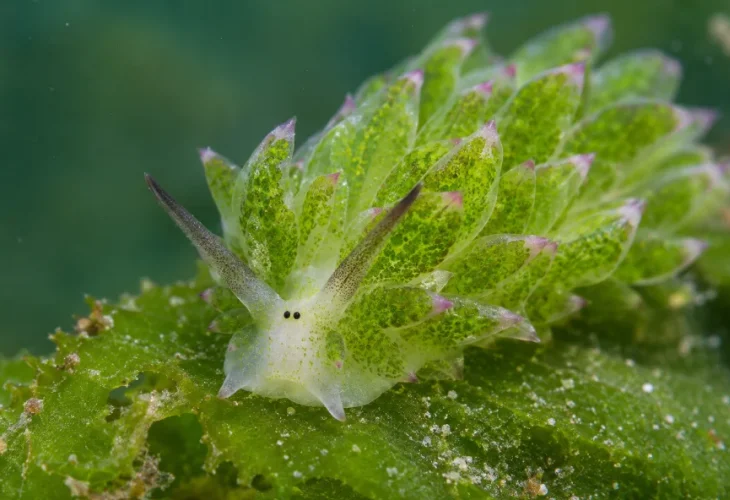
Is it a miniature sheep or a collection of leaves with an adorable face? With two closely spaced black eyes, a pale head, and delicate green projections covering its body, this unusual underwater creature looks almost like a cartoon character. Yet it is a real marine animal, and close-up photography reveals fascinating details that are nearly impossible to appreciate with the naked eye.
The creature belongs to the genus Costasiella, a group of tiny sea slugs, some of which are affectionately known as "leaf sheep." These remarkable mollusks are so small that certain species measure just a few millimeters in length.
What Are the Little "Ears" on Its Head?
The leaf sheep gets its charming appearance from several distinctive features. The two projections resembling sheep's ears are sensory organs called rhinophores, which help the sea slug detect chemicals in the surrounding water, much like a sense of smell. Its dark, closely positioned eyes add to its unusually expressive appearance.
Its back is covered with small, leaf-like structures called cerata, which contain branches of the digestive system. Their bright green coloring, often complemented by pale or pinkish tips, gives the animal its striking appearance in close-up photographs. But these structures are more than just decorative. They are also associated with one of the creature's most extraordinary biological abilities.
How the Leaf Sheep Uses Sunlight
Some Costasiella species can retain chloroplasts from the algae they consume. Chloroplasts are tiny structures found in plants and algae that carry out photosynthesis, the process of using sunlight to produce sugars from water and carbon dioxide.
Normally, an animal digests the food it eats. However, in these sea slugs, some chloroplasts survive digestion and remain functional inside the animal's cells, continuing to perform photosynthesis. This unusual process, known as kleptoplasty, allows the sea slug to temporarily retain part of the biological machinery that algae use to capture energy from sunlight.
Can Leaf Sheep Survive on Sunlight Alone?
Despite their remarkable ability, leaf sheep are not known to survive solely on sunlight. They continue feeding on algae, and the length of time their retained chloroplasts remain active varies between species.
Research examining several Costasiella species found that some maintained functional chloroplasts for relatively short periods, while another species retained them for considerably longer. Scientists have yet to establish precisely how much these chloroplasts contribute to the animals' nutritional needs, and there is no conclusive evidence that these tiny sea slugs can sustain themselves through photosynthesis alone.
Where Can You Find These Tiny Sea Creatures?
Leaf sheep sea slugs can be found in marine environments around Japan, the Philippines, and Indonesia, where they live on the algae that serve as their primary food source. Because of their exceptionally small size, they are easy to overlook in their natural habitat. Magnified photographs make them appear much larger than they really are, revealing intricate details that would otherwise go unnoticed.
For perspective, a Costasiella specimen featured by the Australian Museum in Sydney measures just 3.5 millimeters long. Despite their tiny size, these extraordinary creatures offer a fascinating glimpse into the diversity of marine life and the surprising ways animals can make use of the natural world around them.
 InterestingGlowing Mushrooms: The Mysterious Fungi That Light Up in the Dark
 InterestingAustralia's Pink Lake: How Heavy Rain Transforms the Desert Into a Colorful Wonderland
 Torah and ScienceSmall but Deadly: Inside the World of Venomous Creatures
 Wonders of CreationDo Flies See in Slow Motion? What Science Says

